The Wilhelm Foundation and the Fight to End the Diagnostic Odyssey
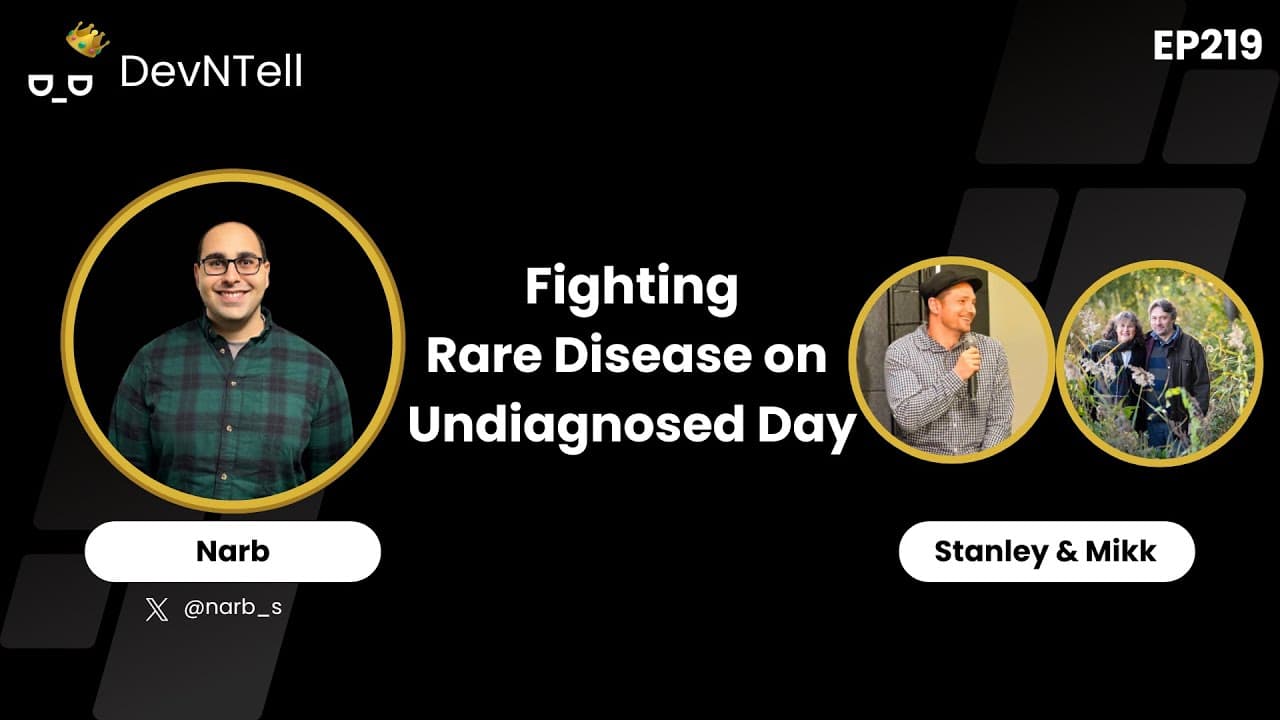
Wilhelm was 16 years old when he passed. One year later, Emma, who was six, died. Two years after that, Hugo was gone. In the span of three years, Mikk Cederroth and his wife Helene lost three of their children to an undiagnosed disease. "We wanted to make sure as much as we can that other families and other kids don't end up in the same situation," Cederroth said on a recent episode of DevNTell, recorded on Undiagnosed Day. That conversation, also featuring AI scientist Stanley Bishop, traced 25 years of work at the intersection of rare disease advocacy, international medical collaboration, and decentralized computing.
Listen on your favorite platform
View full episode detailsThree Children in Three Years
Cederroth is professionally a CTO running his own company in Sweden, but the majority of his time outside that work goes to the Wilhelm Foundation, the organization he and Helene built in the years following their children's deaths. The foundation began with a simple and almost impossible goal: gather the right experts in one room and try to solve the diseases that took their kids. By the time the first conference was ready, Wilhelm, Emma, and Hugo were no longer alive to attend it.
From that first gathering, the foundation helped seed what became the Undiagnosed Diseases Network International (UDNI), modeled on the Undiagnosed Diseases Network already operating in the United States. The UDNI has now held 14 conferences, with a 15th scheduled for October in Italy. What started as a parents' grief became a global infrastructure for coordinating the scientific expertise that families with undiagnosed children rarely know exists.
The foundation originally focused on children, following an initiative called Undiagnosed Children's Day. But the scope widened. "Not every disease manifests when you're young; it could have a very late onset or a long diagnostic journey that for many doesn't even end," he said. The current name, Undiagnosed Day, reflects that broader mission.
The Forty Percent Problem
The phrase "diagnostic odyssey" gets used often in rare disease medicine. At conference after conference, Cederroth said, scientists quote a figure: it takes between five and seven years to get a diagnosis. What that statistic obscures is who is being counted.
"This is only true for 40%, and it's only true for the 40% that actually gets the correct investigations, meaning living in a high-resource country where, well, this is available. And then you have very big parts of the world who doesn't even come close."
The remaining 60% either never receive a diagnosis or fall outside the systems that generate those averages. Of the rare diseases that do get identified, only 5% have any available treatment. For many families, the value of a diagnosis is not a cure. Cederroth described parents who spend years wondering whether something they did during pregnancy caused their child's condition. A genetic explanation, even without a treatment attached to it, can resolve that question and lift a particular kind of guilt.
Doctors, Cederroth noted, often resist referring patients onward. Admitting an undiagnosed case is, in many medical cultures, an admission of failure. Patients find themselves stuck not just because the science is hard, but because institutional incentives work against escalation.
Bishop, who has been an undiagnosed patient himself for about 21 years, framed this as a shift in consciousness as much as a scientific problem. Twenty years ago, undiagnosed patients felt uncomfortable talking to their doctors, and doctors felt equally uncomfortable with undiagnosed patients. That dynamic has changed, but the structural problems remain.
All the King's Horses at Mayo Clinic
The Undiagnosed Hackathon is the Wilhelm Foundation's most concentrated attempt to break those structural problems open. The flagship event has been held at Mayo Clinic, which Bishop described as something like his version of Coachella. Physicians from over 30 countries attend. So do the patients themselves.
That last part is deliberate. Most medical conferences separate the clinical from the human. The hackathon does not. Families and patients stand in front of roughly 150 experts and explain their situation directly.
"They stand in front of 150 experts and they know now some of them are going to just try to figure out what my son or daughter or myself is suffering from," Cederroth said.
Companies including Oxford Nanopore Technologies, PacBio, and Illumina bring their latest tools. At a recent event, participants had early access to AlphaGenome from DeepMind. The diagnostic rate at these events runs above 50%, but Cederroth was specific about what the hackathon is actually designed for.
"It's not the actual diagnosis at the event; it's to try to push boundaries and push the science forward and put, you know, find new ways. And with brilliant minds and big hearts, that's what can be possible."
The next flagship hackathon is scheduled for Singapore in September. A shorter, five-hour mini-hackathon is planned as a pre-workshop at the American Society of Human Genetics meeting in Montreal, bringing some of the most difficult unsolved cases to specialists in genetics and bioinformatics.
HIPAA, GDPR, and a Rubik's Cube
For all the expertise assembled at these events, much of the practical difficulty is not scientific. Bishop described a specific situation that illustrates the problem: a colleague clinic in China holds data relevant to a particular rare disease. A lab at Dell Medical School in the United States has the wet lab capacity to work with that data. Partners in the EU hold another piece of the puzzle. None of these three groups can easily share information with the others.
The reason is compliance. HIPAA governs medical data in the United States. GDPR applies across Europe. China has its own equivalent regime, and SOC 2 standards add another layer. Getting those three groups to collaborate requires engineering that satisfies all of those frameworks simultaneously. Bishop estimated that this kind of compliance work represents roughly 80% of the total effort in many rare disease research projects.
Cederroth had earlier pointed to Sweden's hospital system as an illustration of the same problem at a smaller scale. Sweden has 21 regional health authorities, and medical records from one region cannot be shared with another. For a disease so rare that only a handful of patients exist anywhere in the world, that kind of fragmentation makes coordinated research nearly impossible.
Models Running in a Garage
Bishop's argument is that the developer community, and specifically the decentralized science community, is positioned to address the coordination problem in ways that centralized institutions cannot. He pointed to a colleague at Dell Medical School who runs fine-tuned open-source models on a cluster of Mac Studios in his garage, models that in some cases outperform frontier commercial systems because they carry better scientific context.
The Wilhelm Foundation and Bishop's team are preparing to release an open-source project focused on building agentic tools for physicians: systems that compile test lists, run analyses, generate reports, and handle routine cognitive work that currently consumes physician time. The project is oriented around open-source models that could run locally, not toward replacing clinicians but toward clearing the path so clinicians can focus on harder diagnostic work.
Bishop also described work toward an open standard for collaborative computing, a protocol that would let jobs requiring data, compute, and expertise from multiple stakeholders be coordinated and validated across institutional lines. The analogy he used was DNS, the system that routes internet requests without a human intermediary doing it manually.
Applications for the Singapore hackathon will be open to people from outside the existing medical community. Cederroth described the selection process as an attempt to assemble the best possible mix of backgrounds and expertise, with a limited number of places and a deliberate effort to bring in perspectives that purely clinical gatherings tend to miss.