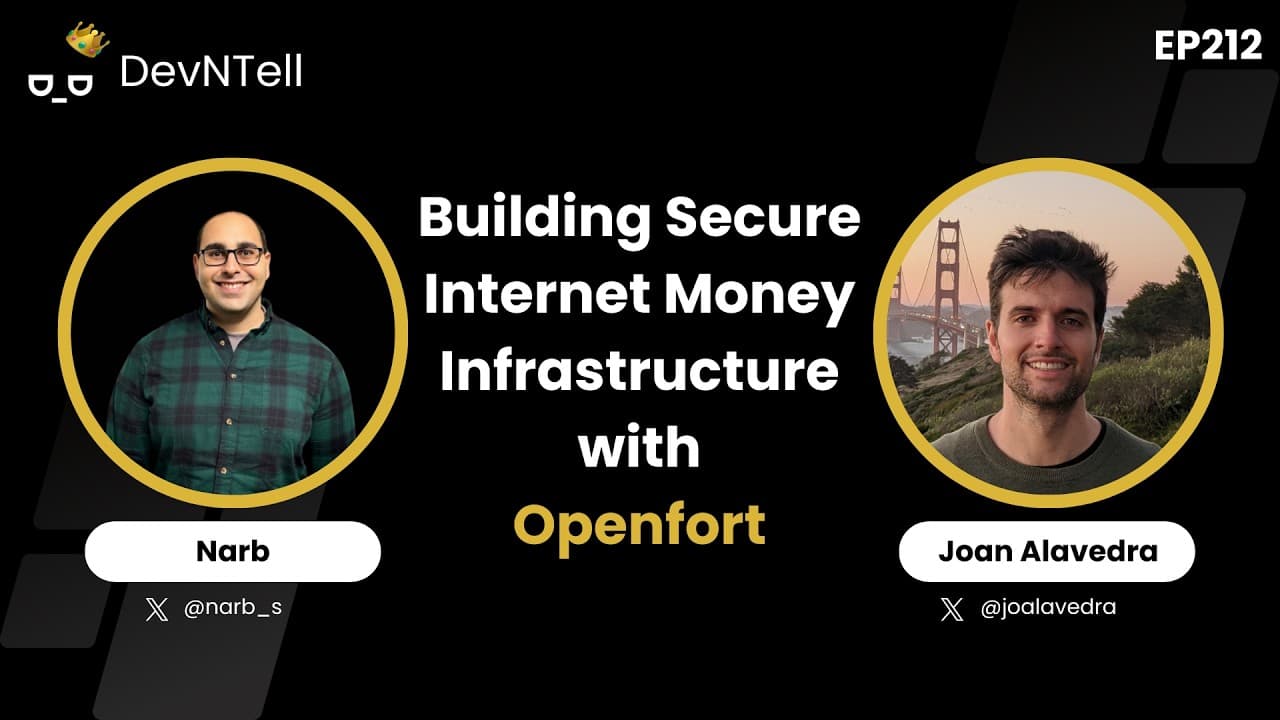
How Openfort Became an Open-Source Wallet Operating System
When someone swapped $50 million in USDT on a mobile wallet and walked away with roughly $40,000 after slippage, Joan Alavedra had what he called "confronting feelings." On one hand, the transaction suggested that self-custody at that scale had become technically accessible to ordinary users. On the other, the result was a clear reminder that access and usability are not the same thing. Alavedra, co-founder of Openfort, has spent more than three years building infrastructure intended to close that gap.
Listen on your favorite platform
View full episode detailsFrom ETHGlobal Hackathons to a Wallet Operating System
Openfort did not start as a wallet company. Joan and his brother and co-founder Jaume came to crypto through the indie hacker community, building traditional software at a time when GPT-3 was the state of the art in language models. Their path into blockchain came through ETHGlobal hackathons, both online and in person, which gave them an opinionated view of the problems developers faced when working with wallets and private key management. The company launched inside the gaming and entertainment sector before broadening its scope to what Alavedra now describes as "an open-source wallet operating system."
The phrase is deliberate. Rather than positioning Openfort as a single wallet product, the framing is about modularity: some developers need to abstract away custody entirely, others need transaction orchestration, and others need paymasters or a secure way to store private keys.
"Openfort is a wallet operating system that helps developers plug the necessary abstractions for them to ship the right product at the right time. For some people that means abstracting the way that they think about custody. For others, it might be they just want a smooth transaction orchestration."
That flexibility extends to how companies integrate. A team building a neobank from scratch might use Openfort end to end alongside partner infrastructure for virtual accounts. A team with most of their stack already defined might only need one specific component.
Chrome Extensions to Embedded Wallets
Alavedra traced the history of consumer wallet UX through three rough eras. Early users managed wallets through Chrome browser extensions. That paradigm has shifted almost entirely to embedded wallets, where wallet creation and key management happen inside an application rather than as a separate plugin. The next phase, in his view, centers on agentic wallets: wallets controlled by or acting on behalf of AI agents, where the central design challenge becomes permission management and automation rather than simple key custody.
Problems that earlier wallet generations left unresolved, like paying gas fees when a user only holds stablecoins, or earning yield from stablecoins quickly, are largely addressed by current tooling. What remains open is how the Ethereum ecosystem resolves competing proposals around account abstraction. Alavedra referenced ongoing debate around a new standard called "frame transactions" versus deeper protocol-level integration, characterizing the discussion as healthy: "it kind of like resembles to like a v1, v2, v3 of normal software products." Progress in that direction means fewer middleware dependencies over time, and less vendor lock-in for developers who build on top of it.
npm create-openfort and the Widget SDK
One of the more concrete products Openfort has shipped in the past six months is a widget SDK built on top of ConnectKit, a wallet connection library originally developed by the team at Family. Openfort forked that project and extended it with email login, passkey support, and social authentication options that the original library did not include. The result is a single command, npm create-openfort, that produces a working implementation covering authentication, wallet creation, and gasless transaction sending via a paymaster.
Openfort also maintains a set of interactive demos at demo.openfort.io, built by a team member named Arnau, that walk through specific UX scenarios: stealth addresses for sending and receiving funds without exposing the recipient address to external tracking, paying transaction fees in any stablecoin including DAI and USDC, and x402 micro-payments that unlock a piece of content upon payment. Alavedra pointed to the x402 demo as an example of what crypto infrastructure can look like outside of purely financial speculation, describing it as "more tangible to a role of a person within a company or within their day-to-day consumption."
OpenSigner and the Non-Custodial Problem
The piece of Openfort that Alavedra returned to most often is OpenSigner, a self-hostable wallet key management system. The motivation behind it came from a pattern he observed in the market: products that described themselves as non-custodial but were not in practice, because private key recovery was possible through an authentication token, or because encrypted key material was being routed back through a vendor's server without sufficient transparency.
"A lot of setups that we saw back at the time were claiming that they were like non-custodial but it was actually not truly non-custodial because you could recover the private key via like an auth token that you can get from your authentication solution, or you actually were back channeling some parts to like your server encrypted. So like all these things and like not having enough transparency on like how the system was designed were kind of like precipitated the idea of like, okay, we actually need to build something here."
OpenSigner is packaged as a Docker container that any project can run on its own infrastructure, making that project the actual custodian of its users' private keys rather than Openfort. The practical benefit, beyond the security posture, is reduced compliance burden: projects that are not taking custody of keys do not face the same regulatory requirements as those that are. Recovery mechanisms are also built in, covering the case where a user loses access to their keys.
Financial Primitives Without Permission
The long-term vision Alavedra described is geographic and economic in scope. His specific examples were a specialized neobank in Paraguay or a wealth management product in Uganda, applications that were previously difficult or impossible to build because of regulatory constraints and the gatekeeping of large financial institutions. The goal, as he framed it, is to make financial primitives accessible to any developer regardless of geography or background, without requiring permission from a bank or government to do so.
That same framing extends to Openfort's current focus on AI agents. The interesting question, in his telling, is not just whether agents can access financial rails through wallets and credit cards, but what services those agents can reach that were previously locked behind high-priced enterprise contracts or simply did not exist. On the day of the interview, Openfort was releasing a CLI tool designed for both agents and developers to interact with the full Openfort infrastructure from the command line, including sending gasless transactions on Ethereum and making investments on Solana.
The company itself remains a collaboration between two brothers who entered crypto through hackathons and have been building together for more than three years. Asked what advice he would give to aspiring founders, Alavedra pointed back to the founding dynamic he shares with Jaume: starting from a place of trust that is "completely different from someone that you just met say six to 12 months in" turned out to be the condition that made everything else possible.