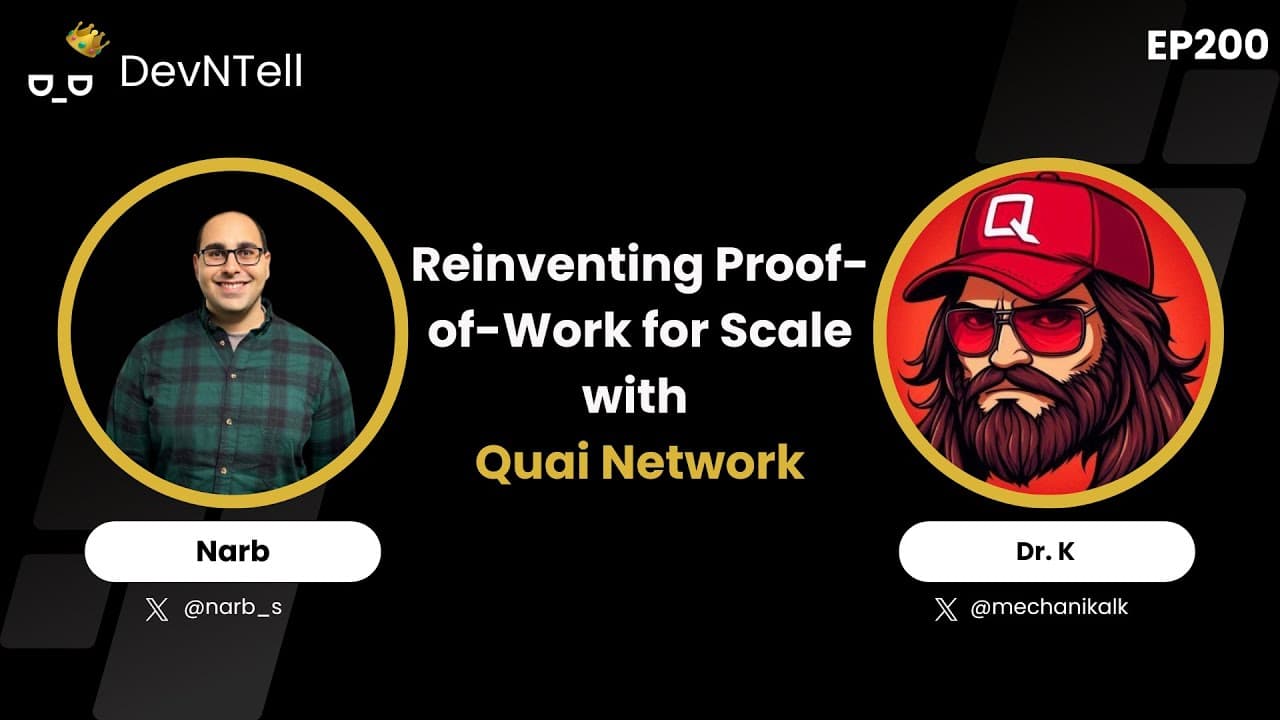
From a National Science Foundation Grant to Mainnet: How Quai Network Scaled Proof-of-Work
In 2018, after finishing his doctorate in engineering at the University of Texas, Dr. K secured a National Science Foundation grant to research a question he had been turning over since his time at ConsenSys: how do you scale a Proof-of-Work blockchain without sacrificing what makes Proof-of-Work worth keeping? That grant became a multi-year research project, then a company, then a mainnet. From concept to launch, the timeline ran to seven years.
Listen on your favorite platform
View full episode detailsSeven Years from Concept to Chain
Dr. K's path into crypto began as a hobbyist around 2012 and turned full-time in 2017 after completing his doctorate. At a ConsenSys spin-out called Grid Plus, he designed and built the Lattice1 hardware wallet. The idea for Quai came in 2018, when he shared the concept with a professor he knew at UT who ran a research group in electrical engineering focused on distributed systems. That collaboration pulled in graduate students and undergrads, landed the NSF grant, and eventually attracted a raise from Polychain Capital in 2022, which allowed the team to go full-time with a larger group.
His reason for staying focused on Proof-of-Work rather than following Ethereum toward Proof-of-Stake comes down to a specific property he calls hard money.
"What gives gold value? The thing that fundamentally gives gold value is the energy that goes into finding, mining, and refining it. So over time, sort of the market value of gold is the cost of producing gold. In Proof-of-Work at least instantaneously that is true."
That energy-to-value relationship is central to how Dr. K frames the project. He also points to economic immutability: changing history in a Proof-of-Work chain carries an enormous cost that grows over time, while in a Proof-of-Stake system a committee can resign changes without that same economic barrier.
POEM and the Multi-Leader Problem
The core technical problem Quai addresses is how to run many chains simultaneously without requiring multiple rounds of communication to agree on the canonical tip. Quai uses a three-level hierarchy called Prime, Region, and Zone. Miners propose composite headers that span all three levels. Depending on how much difficulty their hash hits, they produce a Zone block, a Zone-Region block, or a Zone-Region-Prime block. This lets the system run many Zone chains in parallel, all coordinated through a shared Proof-of-Work hierarchy.
Traditional Proof-of-Work forks because it takes time for a block to propagate across the network. During that propagation window, another miner might find a competing block. In a single chain, the system eventually resolves, but as more shards are added, the aggregate convergence time grows longer. With enough shards, the wait becomes impractical.
Proof-of-Entropy Minima (POEM) addresses this by measuring not just whether a hash meets a threshold, but the full numerical value of the hash itself. Each block is assigned a bit-weight derived from the logarithm of the field size minus the hash. That weight is precise enough that two different blocks almost certainly carry different weights, so the network can pick a winner deterministically without any back-and-forth.
"With Proof-of-Work it's a broadcast-only system. So like once the block hits everybody's nodes, because the rule is deterministic, we all know that we're in agreement. So there's no need to talk, we just need to make sure that we get all the blocks."
Notably, Dr. K said POEM was not part of the original design. The team had built the hierarchical merge-mined structure first and used a rule they called the Hierarchical Longest Chain, which turned out to create unresolvable loops across many simultaneously propagating chains. POEM came later, as the solution to a problem they only discovered after building the system. "We kind of got lucky I guess would be the statement," he said.
Quai Network EVM Compatibility
For developers, the EVM compatibility is close to complete. Quai ships a fork of Ethers v6 called Quais, which replaces the polling model in standard Ethers with actual subscriptions. Nodes push updates to clients when state changes, rather than responding to constant interval queries. Dr. K noted that standard Ethers implementations do not actually use subscriptions behind the scenes, and that the polling overhead can be reduced by "a thousand or more, 10,000X" with a proper subscription model. Contracts that do not anticipate sharding can be deployed as near-copies of existing EVM contracts. Contracts designed for multi-shard environments need to specify sister contract addresses for each additional shard at deploy time.
SOMA and the Net-Neutral Security Model
The Subsidy Open Market Acquisition (SOMA) protocol extends Quai's security by merge-mining with Litecoin, Dogecoin, Bitcoin Cash, and Ravencoin. Miners on those networks receive only Quai as payment. The secondary tokens they would have earned flow to a foundation address, which then sells those tokens on the open market to buy Quai. The result is that miner sell pressure on Quai is offset by continuous buy pressure funded by external hash rate.
At the time of the conversation, SOMA was generating roughly $20,000 per day in volume across those pairs, cleared through centralized exchanges. The longer-term goal is to route that volume through a decentralized exchange built on Quai itself. Because SOMA revenue scales with hash rate, and hash rate scales with token price, the system creates a feedback loop where higher price brings more miners, more miners bring more SOMA revenue, and more buy pressure pushes price higher.
Dr. K described the economics as close to net-neutral. "If we pay out a hundred dollars worth of Quai, we're getting a hundred dollars of another token back. So like on a net-net basis, we don't even pay for our security." The SOMA protocol also creates a loose cryptographic reference to the blockchains being merge-mined, which Dr. K said could enable trustless wrapping of those assets into Quai without a custodial intermediary, a feature no one has built yet.
The Kipper tipping app, available on Android and in iOS beta, runs on Quai and lets users tip one Quai when liking a post on X. It is the kind of low-fee, high-frequency application the network was built to support, where per-transaction costs stay predictable at scale rather than spiking when the network gets congested.