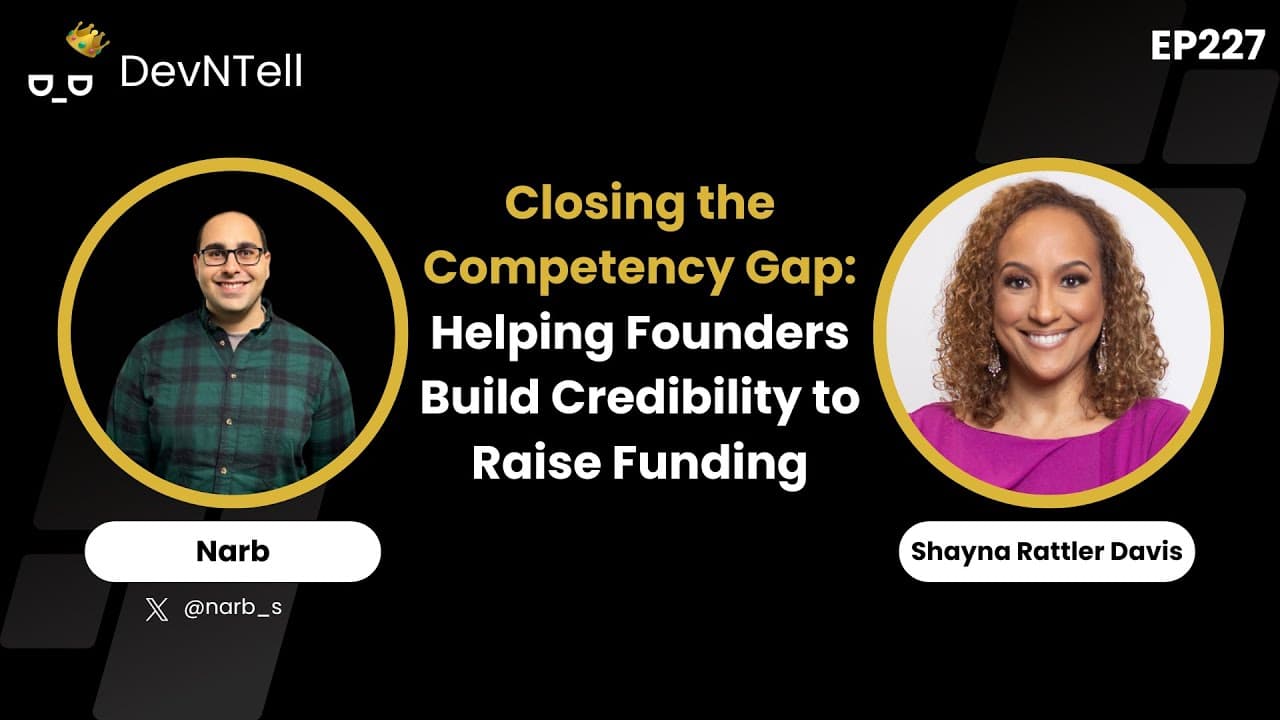
Why Investors Fund the Founder Before the Product
A founder once told his head of engineering and his CTO that they were going to have to start having conversations with Wall Street executives about how the thing they were building would change an entire industry. Shayna Rattler Davis was in the room watching the two of them react. "They turned like ghostly white," she said, "and I said 'Oh wow.'" Davis was the second person hired at that startup, and the moment stuck with her. It is part of the reason she now runs Executive Signals Group, a firm that works with technical founders and leadership teams once they start becoming visible to investors, customers, and media.
Listen on your favorite platform
View full episode detailsThe Founder Competency Gap
The premise behind Executive Signals Group is blunt. "Having a strong product and the right team is no longer enough to get you there," Davis said. She argues that the era when a great product and a brilliant team were all it took has ended, and that the reason her firm exists at all is that she recognized that single fact before most of her clients did. She calls the problem the competency gap. Tech people, she said, are brilliant at building the thing and leading their teams, but they tend to struggle once they have to engage outside the company with non-technical people.
She traces the evolution of the founder's role from the anonymous leadership of an old IBM to the era of Steve Jobs, where the founder became the brand. Today, she points to companies like Nvidia, where the chief executive makes sure his core leadership team is good at influencing externally. She admitted she struggles with the name Jensen Huang, saying she gets it wrong every single time, but the principle remains. The role of the technical leader has shifted from having their head down in code to being expected to build a muscle they have never used before. She views it not as a sign of weakness but as a necessary evolution for the modern market.
Investors Audit You Before the Room
Davis ties the gap directly to fundraising. Investors she talks to tell her that almost every pitch is a good idea and that the tech will look different in three months anyway. "They're not necessarily founding the product as much as they are funding the founder," she said, describing how credibility gets checked long before a pitch meeting ever happens. She warns that relying on the product to speak for itself no longer works when dozens of similar tools exist for something as ordinary as an online calendar scheduler.
these investors they're actually auditing your credibility before you ever even get in the room and so it's like the first mistake is my product alone is enough and the next thing is that my pitch deck is enough
By the time a meeting appears on the calendar, a founder may have already been sized up through their website, LinkedIn profile, or public interviews. Davis notes that a cropped backyard barbecue headshot or a biography that reads like a resume sends a specific message about credibility. She explicitly rejects the idea that this is about being performative. Instead, she wants founders to be more intentional about who they are and what they stand for. Talk to her in six months, she warned, and a founder who leaned only on features will regret it.
The Executive Influence Framework
Davis breaks her work into three parts: leadership identity, leadership branding, and leadership messaging. Most people want to skip straight to the messaging, the actual words on the page. She says the foundational work has to come first or the messaging never lands. To explain what she means, she uses a surgery analogy. A patient with a broken hip does not care that the surgeon will make a two-inch transverse cut. The patient cares whether they will walk afterward without pain and without a limp. Founders, she said, too often describe the buttons and the back end instead of the outcome people actually want.
Her core exercise asks every member of a leadership team a single question: what is your unique point of view about what we are building? If they cannot answer it in thirty seconds without naming the product or the company, there is work to do. She traced it back to her own decision to join that startup. She believed in the founder and his vision of democratizing investing for everyday Americans before she fully understood the product or the industry, which took her four or five months. Leadership identity, she said, "has everything to do with who you are what you stand for and where this industry is headed," and that work has to exist before any media training or positioning language.
Technical founders often get lost in the sauce, overcomplicating both the product and its explanation. Davis argues that the storytelling does not have to be grandiose. It is about being a real person and explaining why the work matters. If a founder assumes the product will speak for itself, they may find that it sounds exactly like every other product in a crowded category.