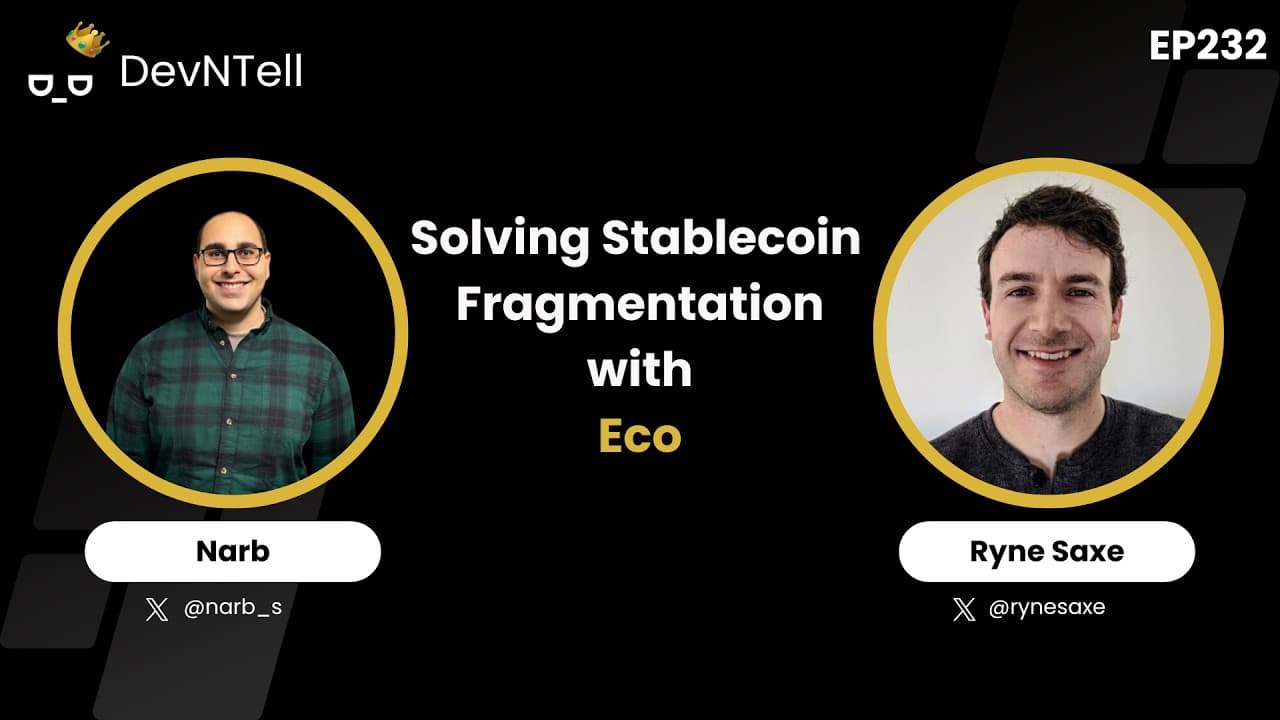
The Stablecoin Rubber Band: Ryne Saxe on Routing Money Across Chains
Ryne Saxe started building Eco in 2018, a timing he now describes flatly as "too soon for stablecoins." The company outlasted the gap between that early bet and the present moment, when stablecoins have turned into one of the most talked-about categories in crypto. It took four or five years for the market to mature, rather than the two he initially expected. "Fortunately, we're still here," Saxe said, describing the long wait as a rubber band that stretched for several extra years before finally snapping into the current period of rapid adoption.
Listen on your favorite platform
View full episode detailsA Meandering Non-Linear Background
Saxe reached crypto through an unusual route. He had a technical, builder-oriented background in physics but was practicing law when, as he put it, crypto "lit the nerd up in me again." During that career season, he worked on technology transactions, observing why major companies acquire startups and how those products are folded into larger systems. The experience gave him a vantage point on the legal and regulatory hurdles that often stall new financial technology.
He argues his story is common in the field precisely because crypto pulls together disciplines that rarely sit in the same room. His own team at Eco includes people with similarly meandering, non-linear backgrounds who select for the intersection of hard science and economic policy.
In my opinion, it's because crypto combines these disciplines and interests that are very, very difficult to combine in the same space. So, you know, like cryptography, harder science interests are relevant here, economic interests are relevant here, legal interests are relevant here, and regulatory interests.
The founding team knew payments already, from card processing to cross-border transfers, and knew where that stack was clunky. Bitcoin and Ethereum, Saxe said, were interesting as stores of value or compute but did not behave well as money. That gap pointed them toward the concept of a stablecoin. Eco first tried to design its own digital payment currency, then dropped that idea to focus on the infrastructure underneath, building for the stablecoins that actually gained traction.
Keeping a Dollar a Dollar
When Eco started, the open question was how many blockchains there would be. Now, Saxe said, the debate is how many stablecoins there will be. Eco sidesteps guessing by concentrating on the wholesale market: fewer than ten stablecoins driving real volume, and fewer than fifteen chains that act as liquidity sinks for them. The routing problem lives between those points, and Eco does not chase the long tail of experimental assets.
His framing of the fragmentation problem is that it turns stablecoins into a currency exchange market, and a jumpy one. A dollar on one chain is not always exactly equal to a dollar on another chain after margins, spreads, and finality times are calculated.
The thing that people need to sort of realize about the fragmentation problem statement is that it basically makes stablecoins a forex market, and just a really, really sensitive one, where your dollar is not exactly a dollar between source and destination, there's margin, there's some spread there.
That spread widens across chains with different finality times, and it can turn hostile where MEV searchers are active. Keeping a dollar close to a dollar means traversing that market with a high degree of sophistication. Eco positions itself as the router that does it, whether the hop is across DeFi markets on one chain or between venues on separate chains. As he put it, "Really good routers are very, very valuable in the world," the kind of value that already exists in traditional finance and that Eco wants to hold in the on-chain economy.
A Router That Adapts at Runtime
Eco's routing platform is non-custodial, which Saxe treats as a core detail rather than a footnote. When an order is created, a dedicated smart contract is spawned to handle its instructions. Once the order is transmitted and validated, the original vault contract for the funds self-destructs. That structure lets Eco serve customers who cannot accept custody risk in flight, because it removes a trust assumption and simplifies their compliance position for institutional audits.
The piece he was most willing to call alpha is a router that adapts as it executes. Because a single basis point of movement matters for stablecoins in a way it would not for a long-tail pair, Eco spent the last year building something that defends against that in real time. Saxe said the router can compile arbitrary conditions into bytecode that runs at execution time, giving what he described as zero block latency and all-or-nothing execution against a user's conditions. If the transaction does not clear those conditions perfectly, it reverts fully rather than leaving a partial state.
Right now that router only shows up inside Eco's Routes API. The news Saxe shared is that Eco plans to open it directly to developers through an SDK, built natively cross-chain, including EVM to SVM routing. He pointed people to follow Eco on X for a studio with recipes and a request for beta SDK access, and said the announcement would come this quarter. Alongside Routes, Eco already offers a concept called verified liquidity for whitelisting specific liquidity sources, plus a CLI. Saxe openly asked for developer feedback on whether Routes should stay one API or split into several distinct interfaces based on flow types.
The Best FX Market That Has Ever Existed
Most stablecoin attention lands on USDC and USDT, both pegged to the dollar. Saxe is looking past that. "I'm extremely bullish on non-USD stablecoins," he said, arguing that a mature exchange market needs stablecoins for every currency with international demand. His line on the ceiling here is blunt: "Stablecoins should be the best FX market that has ever existed."
The clearest starting corridor is dollar to euro, some of which has already appeared. He had also been bullish on Brazilian Real stablecoins, pointing to an active exchange corridor between the Real and several foreign currencies. That optimism ran into a wall when Brazil enacted a recent policy adding regulatory and licensing hurdles to moving stablecoin Real in and out, which Saxe expects to suppress that pipeline for a while even though it had been growing with some of Eco's partner companies.
Waiting for the Agentic Spike
On AI agents transacting with stablecoins, Saxe put the current state at "demo state" and said he is on record predicting it blows up within twelve months. He expects a step function spike in the use case that surprises people, much like the sudden jump in personal agent use earlier in the spring. He was candid that the basic version is dull: "it's not that interesting in my opinion for an agent to send USDC."
He sees two ways Eco is ready for the moment. The runtime router suits an agentic transactor that cannot practically deploy and destruct a smart contract on the fly but could write a transaction script with that level of control. Eco intends to give that router an agentic interface and to demonstrate an agentic flow in the studio demo. The second piece is discoverability, running a proactive marketing engine so the models can find the tool if it fits what they are trying to do.