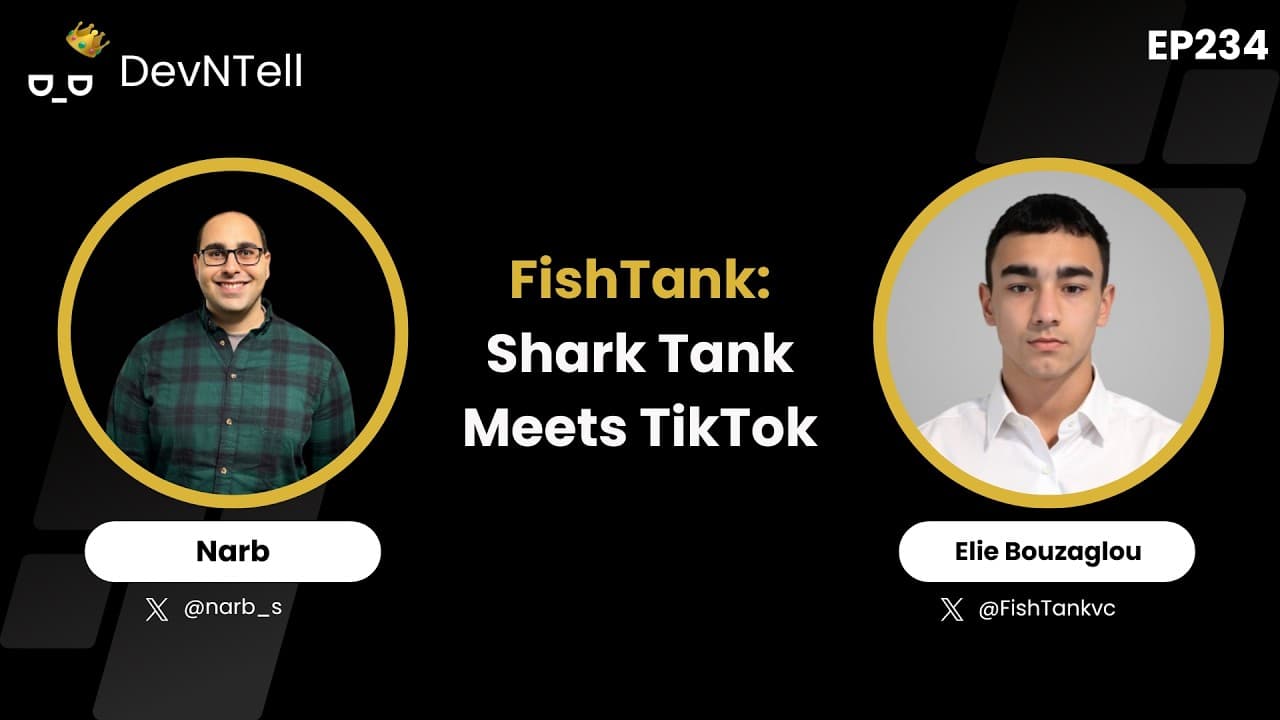
The End of the Thirty-Page Pitch Deck
At sleepaway camp, the canteen sold drinks only from 12:30 to 1:00, right when campers were eating lunch. By 3:30, when sports ended, everyone was thirsty and the canteen was closed, so campers were stuck drinking water. Elie Bouzaglou, who was about 11, bought a stack of cans and started selling them at exactly that hour. The operation scaled until he bought a used mini fridge from another kid at the camp, which meant he could sell cold drinks while parents hauled warm ones back from Walmart on visiting day. "Who wants warm drinks, but I have a fridge now," Bouzaglou said.
Listen on your favorite platform
View full episode detailsBouzaglou carried that pattern into his first real company, WebNix. It started as a web agency because he liked code, but as automation tools became accessible, he shifted his focus from working in the business to working on its operations. He developed a system using scraping tools to generate lead lists for a team of commission-based salesmen. When a prospect expressed interest via a Google Form, the data was fed into an n8n workflow that used OpenAI to generate a custom website mockup through Lovable. The system was designed to wait three days before delivering the result to the prospect to maintain the appearance of manual labor. This operation eventually expanded to include a team of roughly 15 to 20 salesmen who only received payment upon successful Stripe invoices.
Jordan Belfort Mode
To improve the performance of his sales team, Bouzaglou built an internal tool called Prospector. He noticed that his salespeople often lost deals without knowing why, a problem he described as shooting blind.
If you've ever been in sales, you know that it's basically like putting a blindfold on and trying to shoot basketball hoops, because you never know what you're doing wrong.
Prospector allowed salesmen to upload their recorded calls for analysis. The system identified specific moments where a pitch failed and offered alternative phrasing. It also included a roleplay mode where salesmen could practice their delivery against an AI that mimicked the specific prospect's behavior up to the point of friction. They could repeat the exchange and receive another rating until they scored. Their positive response convinced Bouzaglou to consider Prospector as a standalone consumer product. He envisioned a go-to-market strategy built on what he called Jordan Belfort mode, utilizing user-generated content for virality. However, scaling a consumer application required capital that his agency revenue could not sustain.
His initial attempts to raise money through established crowdfunding platforms like Republic and Wefunder resulted in rejections. He observed that these platforms were often dominated by traditional industries, such as cement companies with 100 employees, that did not necessarily appeal to a younger generation of investors. The requirement for extensive documentation was a primary point of friction. Bouzaglou noted that asking regular people to invest in a company requires a level of excitement that a static page often fails to provide. The existing model relied on founders submitting voluminous pitch decks that prospective investors were unlikely to review in full.
Ten Thousand TikToks
Bouzaglou identified a disconnect between how modern founders communicate and how traditional fundraising platforms operate. While building in public was becoming a standard practice on social media, the fundraising process remained tied to outdated formats. The friction involved in reviewing long-form documents appeared increasingly out of sync with a digital environment characterized by short attention spans. As Bouzaglou explained:
People don't want to go through a single pitch deck, but they'll go through 10,000 TikToks or whatever. Why can't we just do it like that?
Short-form video, he argued, shows more signal than a deck and attracts both better founders and more investors. FishTank grew out of that argument. The platform replaces the one-time campaign page with a continuous narrative of 30 to 60-second video updates. Founders create an Innovation Profile containing a pitch, demo, and team information, while investors browse a vertically oriented pitch feed resembling TikTok or Reels.
The premise is that investors can observe execution and progress over time rather than just a polished fundraising snapshot. This discovery interface allows for a feedback layer called Thoughts, where the community can validate ideas before they become full campaigns. Bouzaglou described a lifecycle that takes an idea from initial validation in the shower to co-founder matching and eventual fundraising, all in the same place.
The Wire Before Final Exams
Before FishTank itself was ready, Bouzaglou tested its central premise on Instagram. He wanted to retire the risk that professional investors would not take a video pitch seriously. The strategy proved successful when he attracted interest from over 30 potential investors. While many were not accredited and could not participate in a private round, the content eventually reached a venture capitalist.
We basically validated if the format works before even having the product built.
After a series of discussions, the investor committed to a check, and the funds were wired one week later. This occurred while Bouzaglou was still in high school, shortly before his final exams. The successful raise served as a proof of concept that video content could be a tool for professional fundraising. He noted that five years ago, the concern that social media was only for kids dancing might have been valid, but it no longer holds when world leaders and major institutions utilize the same channels.