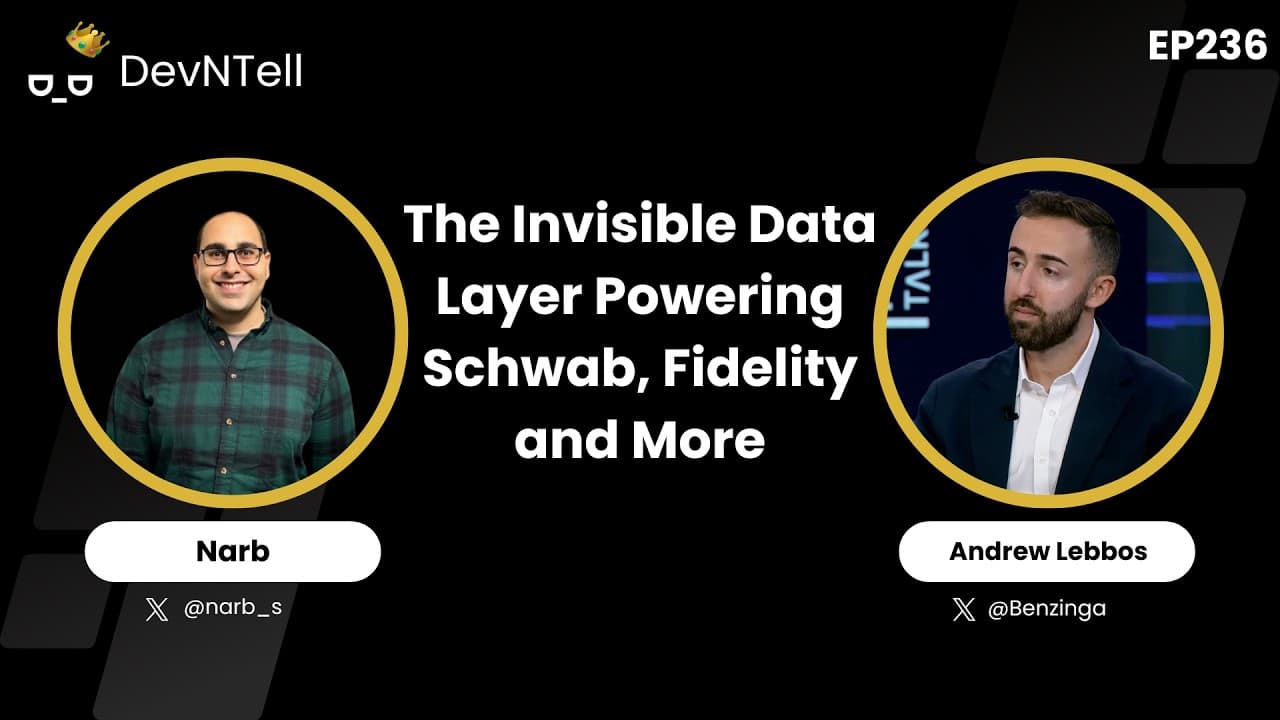
The Data Layer Grounding Financial AI: From Detroit Fiber to Desktop Terminals
Andrew Lebbos went to Wayne State University in downtown Detroit in the years after the city's 2011 bankruptcy, and the thing that pulled him toward tech was not finance. It was internet access. Parts of the city had no reliable connection at all, something most major cities take for granted, and this was before Starlink. Rocket Mortgage, then still Quicken Loans, funded a startup called Rocket Fiber to lay fiber lines under major roads whenever construction crews opened them up, connecting businesses as they went. Lebbos joined that team and stayed with it until Everstream acquired it.
Listen on your favorite platform
View full episode detailsI studied economics, and people talk about utilities historically like electricity and water, but they don't really talk about internet, and internet is like water for developing a city. I fell in love with the project, joined the team, they got acquired by Everstream, and then Benzinga became the coolest startup in Detroit.
That framing, from Lebbos, is what got him hooked on building things inside a city trying to turn itself around. His route to Benzinga ran through a poker game. He had been dropping by Benzinga's trader events and speaker nights during college, since the office sat about a mile and a half from campus, and when a job opened he heard about it from someone he played poker with who ran the company's non-profit. He applied, joined in 2019, and by his own count was roughly employee 34. Seven and a half years later he is SVP of Data Licensing.
Employee 34 and the Five Companies
When Lebbos started in 2019, Benzinga had about 30 people. Then COVID arrived, the in-person events business collapsed, and management made rational decisions to protect the core business. Headcount dropped to around 18 people. What came next was the retail trading boom. Stimulus checks landed, new brokerages appeared, and a wave of people wanted to read about what was happening in the market. Benzinga, which writes market stories in 500 to 1,000 words with no acronyms and a plain structure of what happened and why it matters, was positioned for exactly that moment.
Lebbos marks the start of the first crypto mania by a familiar signal. "When your uncle starts talking about it at Thanksgiving, that's how you know," he said. The company expanded its employee count by 10x between mid-2020 and 2022, got acquired by the private equity firm Beringer Capital in October 2021, and, in his telling, was busy enough to turn deals away. It was a run and gun atmosphere because the volume of business was so high.
It felt like I've worked at four or five different companies: pre-COVID, COVID, early acquisition, post-acquisition, scale-up.
The acquisition changed the day-to-day. The early stretch was run and gun and disorganized because the space was so new. Afterward came the work of professionalizing. The questions shifted from which endpoints to build to whether the company could support 300 clients instead of 30. Lebbos credits Beringer with bringing in adults in the room, people with specific backgrounds for specific functions like marketing, support, and engineering. The CEO could no longer answer the phone for support tickets after client number 50. This professionalization helped Benzinga maintain its Detroit roots while operating on a global scale, serving clients across APAC, Europe, and the United States.
The Thinkorswim Deal and API Productization
Benzinga is still known to most readers as benzinga.com, a breaking news site that Lebbos says draws roughly 18 to 20 million visitors a month. The data business that now powers other companies traces back to a single request in 2011. TD Ameritrade had bought Thinkorswim, which wanted to be the first retail platform built like an institutional one, and it came to Benzinga with a simple ask: put your news in our platform. That was the spark. Competitors like TradeStation and TradeZero followed, and over time Benzinga realized the datasets its writers used to produce the news were valuable on their own.
Writers had been aggregating analyst ratings from sell-side banks, upcoming IPO calendars, company logos, and more. Benzinga broke those into separate products. In 2019 there were six or seven; today there are more than 30 API endpoints. The catalog includes market news, corporate actions, conference call transcripts, insider trades, and the "Why Is It Moving?" feed, which provides a concise explanation for an asset's price movement. This data layer allows platforms to add news and context without operating their own full newsroom and normalization pipeline.
Scaling the Newsdesk Against Content Slop
When commercial AI arrived, Benzinga's first reaction was worry. Lebbos said the fear was that AI would write news faster or better, or flatten the value of its datasets. The reality ran the other way. As content slop and misinformation spread, demand rose for sources people could trust. Benzinga leaned on a newsdesk of 55 people with direct relationships to sell-side banks, company CEOs, and industry experts. These relationships produce content that models cannot generate on their own.
We will never just pump out AI garbage; we have a newsdesk team of 55 people who have direct relationships with sell side banks, company CEOs, and industry experts to produce engaging, informative content that AI cannot produce on its own. Furthermore, AI models need objective source content!
The more surprising part was the buying side. AI companies need objective source material, and because of how Benzinga structured its endpoints and newsfeed, models began licensing its content directly to ground their answer engines rather than scraping ambiguous sources like Reddit or sponsored links. Lebbos said licensing to LLMs was the company's biggest growth segment last year, and that it was not even in the budget. He tied it back to a mission of democratization of finance, since AI now lets a retail investor ask tailored questions about an earnings report and get an answer pitched at their level.
By asking partners what their users are requesting, the company identifies niche but valuable datasets. The Government Trades API, for instance, tracks the market activity of politicians. Interest in Nancy Pelosi's trades and other legislative figures prompted the team to build a structured feed that retail platforms could offer to their users. Similarly, the demand for conference call transcripts led to the development of an API that provides sentence by sentence data, a feature that has become critical for AI applications that require complete, human-vetted transcripts to avoid hallucinations.
Prediction Markets and the 2026 Roadmap
Scaling the licensing team has required a non-traditional approach. Lebbos runs it with a team of five full-time salespeople spread across APAC, Europe, and the US, each carrying a specialty such as AI or institutional accounts. He still keeps a few key accounts himself to keep his finger on the pulse of what is working. Marketing is the newest addition, with a fresh hire and new branding intended to reflect the company's status as a professionalized scale-up. The client relationships are built around smaller, personalized events like a World Cup watch party in London or a suite at a Nets game.
As of August 2026, the product queue continues to move at a pace of roughly one new product per quarter. The company recently launched a corporate Events Calendar API on July 21 and a Prediction Markets Newsfeed on August 4. The prediction feed is designed to help traders understand how changing odds in political or event based markets affect traditional market holdings. The expansion into private markets has also been a focus, covering pre-IPO names like OpenAI and Anthropic. These specialized feeds allow brokerages to keep users engaged on their platforms by providing actionable context that goes beyond raw price data. For Benzinga, the focus remains on providing the underlying data layer that powers the next generation of trading platforms, from major online brokerages to the latest AI-driven answer boxes.