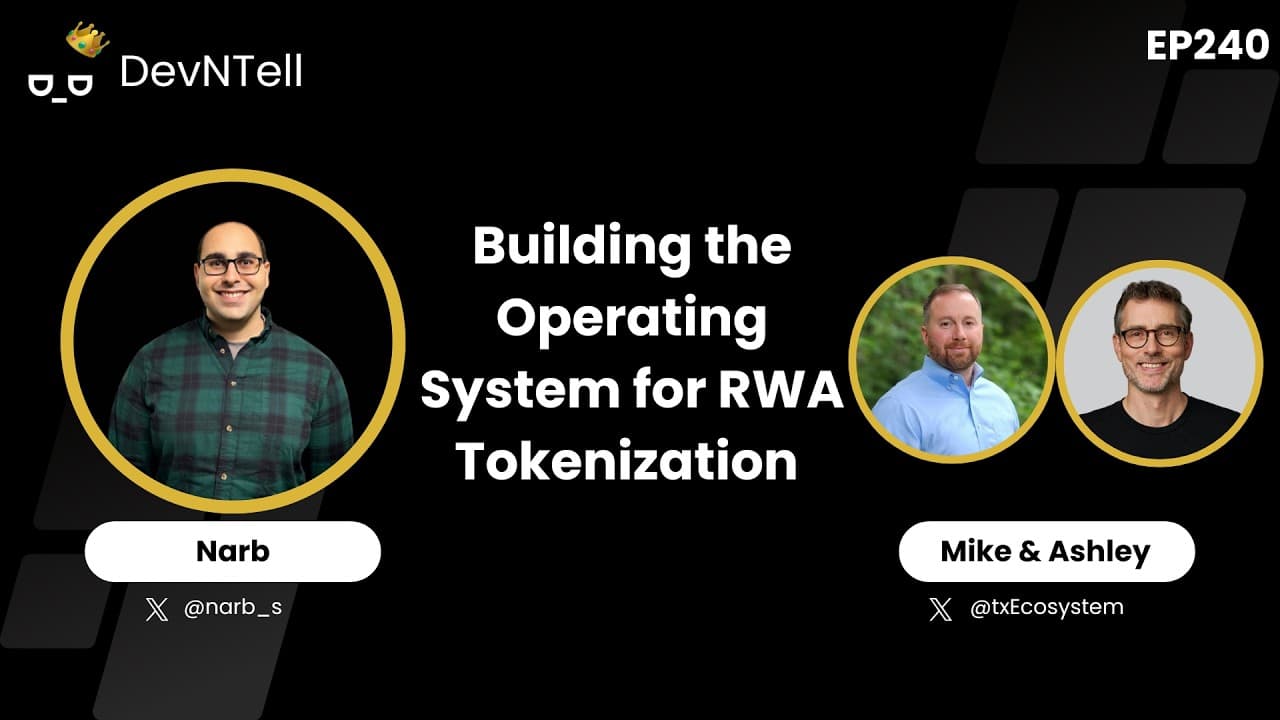
The Architecture of a Unified Real World Asset Marketplace
Ashley Ebersole joined the Securities and Exchange Commission in early 2015, at a point when the agency was still deciding how to treat a technology most of Wall Street had barely registered. Ebersole, a lawyer who had spent an entire career in financial regulation, landed on the internal working groups studying how the SEC should approach crypto assets. It was, by Ebersole's account, a strange split-screen period, with serious builders on one side and opportunists on the other.
Listen on your favorite platform
View full episode detailsThere were some great actors in this space. There were a lot of bad actors in the early days who were trying to capitalize on the fact that it was a new and unfamiliar technology and make money in illegitimate ways.
Before joining tx about a year ago, Ebersole served as General Counsel of the DeFi aggregator 0x, and later counseled crypto companies from a New York law firm. In the early years, a major firm was not the kind of place crypto startups thought to call, and clients only arrived later as the industry matured and legal counsel stopped being optional.
The Sologenic and Coreum Merger
Mike McCluskey came to the same place by a different road. At Fidelity Investments, he sat near a small team researching Bitcoin, an asset he says he had never actually heard of at the time. That exposure led to a couple of years at a fintech accelerator, where payments and lending startups streamed through the program but the blockchain companies kept standing out. He took a blockchain course at MIT and got involved with the Boston Blockchain Association, then met the co-founders of Sologenic and joined roughly three years ago to build out the tokenization business.
tx is the product of a strategic merger between two existing crypto projects, Sologenic and Coreum. Sologenic was founded five or six years ago, and its team built a Layer 1 blockchain, Coreum, designed specifically for tokenization. That consolidation, put to a community vote that passed in favor, is the foundation McCluskey and Ebersole are now building on. McCluskey frames the pitch plainly: tokenization requires technology, regulatory access, and liquidity in one place, and most companies solve only one piece of that at a time.
Everything With Value Becomes a Token
McCluskey's thesis is that any asset with value eventually gets a token attached to it. Real estate, commodities, collectibles, intellectual property, he expects all of it to become tradeable, fractionalized, and settled instantly. He points to the projections and to Larry Fink of BlackRock, who has expressed a similar view.
"I think $30 trillion is going to be on-chain in the next five or so years," McCluskey said, positioning tx for what he calls an inevitable future rather than a speculative one.
The product ambition follows from that.
Our end goal really is to be the Robinhood or the Amazon of tokenized assets, where you can go onto one app, have your tokenized stocks and ETFs, real estate, commodities, collectibles, all in one place on-chain.
Ebersole adds the part that, in the co-founders' view, is still broken. Right now, buying tokenized real estate means going to one place, and buying tokenized intellectual property or collectibles means going somewhere else, with liquidity siloed inside each destination. The tx idea is to connect regulated providers so that a person can transact in tokenized assets, find a regulated provider to complete the trade, and have it all settle on the tx chain. tx describes itself as a technology provider, not a broker-dealer, exchange, or custodian, and it leans on independent regulated entities for the parts of the process that require a license.
Apples and Oranges at the SEC
Because Ebersole was inside the agency during its earliest crypto deliberations, the regulatory arc gets a firsthand telling. The SEC's DAO report drew an early line, saying that an asset meeting the criteria of a security would be treated as one regardless of the crypto wrapper. Ebersole's frustration was that the guidance identified securities without adapting the surrounding rules for custody and offerings to the new technology. Conversations with staff were still possible in that era. Then, under the prior administration, those conversations shut off within about a year, and the environment turned sharply adversarial.
The change since then, in Ebersole's words, has been "apples and oranges." The current SEC chair has worked with the industry before, and staff across the agency are described as both versed in the technology and interested in it. Ebersole is cautiously optimistic that the shift holds, while allowing that a few years is as far as anyone can safely predict.
I do think that there were a lot of good actors who were trying to do right and were talking to the SEC. You could have those conversations then. Was there fraud? Yeah, there was undoubtedly fraud also, but that wasn't everyone by any means.
McCluskey backs the point with a recent example. "Our team met with the SEC Crypto Task Force recently and had a very productive conversation," he said, adding that they walked through the company's Smart Token technology and infrastructure and found the staff receptive.
Programming to be at the Token Level
The technical piece that Ebersole singles out as most interesting is how tx handles rules. Rather than relying only on smart contracts sitting on top of an asset, tx builds controls into the asset itself. The underlying architecture is a Layer 1 blockchain using bonded proof of stake, employing WebAssembly smart contracts and Inter-Blockchain Communication (IBC) for interoperability.
Our Smart Tokens are a huge part of this because they actually allow programming to be at the token level. So for geographic restrictions, for whitelisting, blacklisting, for freezing, that sort of thing, that's all programmed in.
These capabilities, minting, burning, whitelisting, freezing, clawbacks, and transfer restrictions, are configured when an asset is issued and execute natively on the chain through Cosmos SDK modules. Ebersole's argument is that this makes the tokens more usable from both a developer and a regulatory standpoint, because they can be controlled in ways ordinary tokens cannot.
On the developer side, McCluskey pointed to the tx Super App, available on Apple and Google Play, which reached approximately 125,000 downloads within a month of launch. The company runs a Developer Hub with tools and resources, and recently passed a community vote on an economic program with three parts: a tokenomics component, a programmatic buyback, and a builder track. McCluskey was explicit that the builder track is not a standard grant program. Backed by Corenest VC, tx is open to joint ventures and revenue sharing with teams building on or adjacent to its chain, and he repeated the invitation to reach out through partnerships@tx.org, X, or LinkedIn.