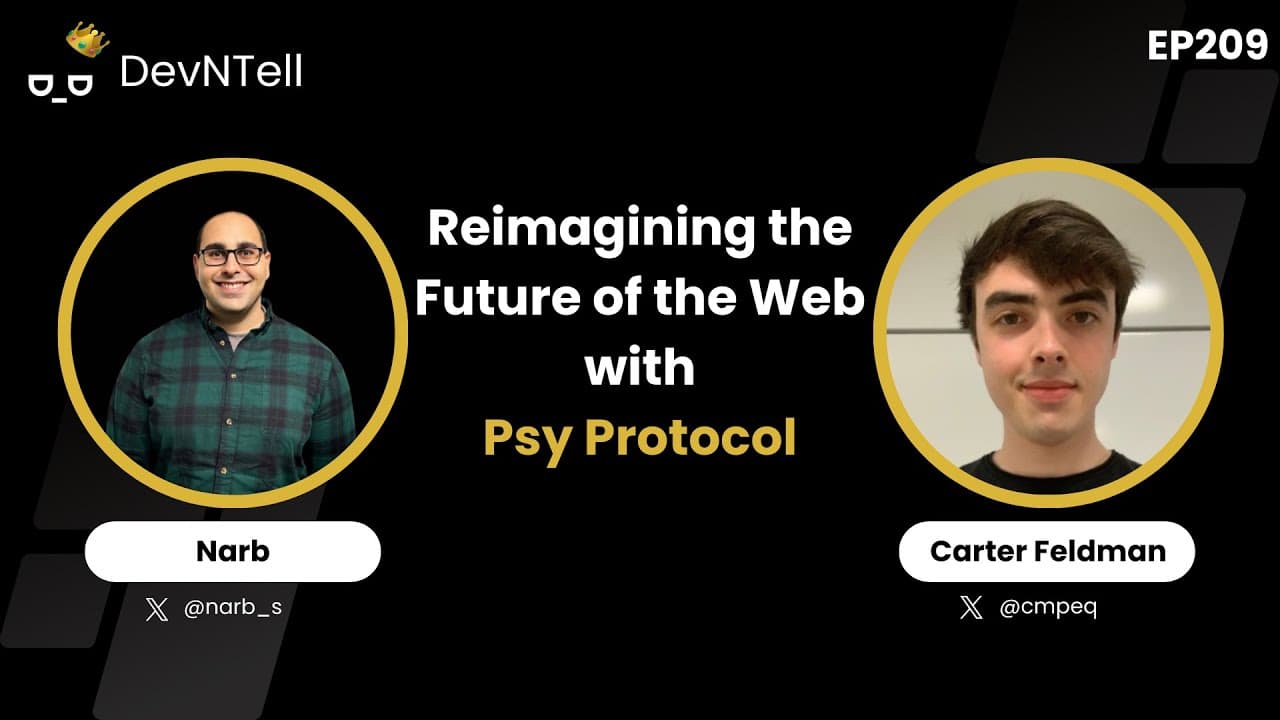
Psy Protocol's Proof of Useful Work Puts 9 Million Transactions in a Single Block
Carter Feldman received his first Bitcoin payments around 2012 or 2013, collecting them as part of a grey-hat hacking collective called Xbox Underground. He was, by his own description, "probably the best-known Call of Duty hacker on the Xbox 360" at the time. That background, equal parts cypherpunk curiosity and practical mischief, sits at the foundation of Psy Protocol, the layer-one blockchain Carter now leads as founder and CEO.
Listen on your favorite platform
View full episode detailsThe core premise behind the existence of Psy Protocol is that most existing blockchains have not actually delivered on the promises Web3 made. Carter puts it plainly: he wants "a user-centric internet where you are not the product and the internet is a tool for your betterment rather than a tool for large companies to make money off of you." Psy is his attempt to build a chain that can run internet-scale applications, preserve privacy by default, and support smart contracts, all at the same time.
Proof of Useful Work and a Block with 9 Million Transactions
The mechanism Psy uses to build blocks is called Proof of Useful Work, and it departs from standard proof-of-work in a specific way. On Bitcoin, every miner races to solve the same hashing problem, and adding more hash power to the network does not increase its capacity for users. Carter draws a direct contrast with how Web2 infrastructure scales: when more servers join, throughput goes up and users wait less.
Proof of Useful Work replaces that competitive hashing with cooperative zero-knowledge proof generation. Miners around the world take batches of user transactions, generate zero-knowledge proofs for them, and then aggregate those proofs up a binary tree. Because the height of a binary tree grows as the logarithm of the number of leaves, the time required to build a block grows much more slowly than the number of transactions in it. The end result is a single recursive proof that verifies every transaction on the chain from genesis and can be checked on a personal computer in roughly half a millisecond.
During the episode, Carter shared a block explorer animation showing an actual block Psy produced. It contained 9 million transactions. The explorer lets anyone copy a command, run the prover locally, and reproduce any node in the proof tree to check the timing figures independently. Carter is aware that TPS claims in the blockchain industry are frequently overstated, and the self-verification tooling is a direct response to that skepticism. Canonical ordering across blocks is determined by total gas fees paid, so the chain with the most cumulative gas fees is treated as the authoritative history.
Carter also spent time on censorship resistance as a motivation for staying with proof-of-work rather than proof-of-stake. On proof-of-stake chains, he argues, node operators have turned block production into an adversarial game:
What we've seen on these proof-of-stake chains is that the nodes have turned into PvP servers where you're playing against the people that operate the infrastructure. They are trying to profit at your expense. They're trying to exploit the fact that they're infrastructure providers to squeeze extra money, to steal from you, and those are called sandwich attacks.
Privacy as Infrastructure for AI Payments
Carter spent a significant portion of the conversation on the intersection of privacy and AI, and his framing is more practical than philosophical. The scenario he keeps returning to is payments: if AI agents are going to handle purchases on behalf of users, the transaction records for those purchases need to be private by default.
He asked whether anyone would feel comfortable publishing their credit card history in public. The analogy maps directly onto how most blockchains currently work. Every transaction is visible to every participant, which is how trustless verification functions without ZK, but which also means spending patterns are permanently public. Adding zero-knowledge proofs to the consensus layer is what allows Psy to keep verification open while keeping individual transaction details private.
The programmable key system Psy is building takes this further for agentic use cases. Public keys on Psy are constructed as the hash of a verifier key for an arbitrary zero-knowledge circuit, which means the rules governing what an agent can do are encoded directly into the cryptographic key itself rather than into a prompt or an off-chain policy. Carter describes it this way:
You can build an account in our account abstraction because we have these programmable keys. You can set reasonable spending limits. Or you can say you can only work off of this vendor list, so don't spend all of my money or send it to some random people. These things aren't logic that you put into the prompt for your Claude or whatever, it's mathematically guaranteed by the constraints of the circuit that is required to generate a signature proof.
The practical implication is that an AI agent operating on Psy cannot exceed its authorized spending or transact with unauthorized counterparties regardless of what instructions it receives through a compromised prompt. Carter sees this as the missing piece for AI-driven commerce at scale, particularly as he expects AI agents to handle an increasing share of routine purchasing decisions.
Rust Contracts and a Browser-Based IDE
Smart contracts on Psy are written in Rust. Carter describes the team as "crab people," using the rustacean terminology that has become standard in Rust communities. He compares the experience favorably to writing Solana programs, though he concedes that comparison sets a modest bar.
The more notable developer tool Psy has been building is a browser-based IDE modeled on Remix, which is widely used in the Ethereum ecosystem for quickly prototyping and testing Solidity contracts. Carter's version for Psy replicates what he considers Remix's most underappreciated feature: the ability to simulate multiple blocks and observe how contracts interact across different states without setting up a local environment. The tool was close to launch at the time of the episode.
Psy is currently on testnet. Mainnet is planned without an initial token, with gas fees subsidized in the early period to allow privacy applications that are already waiting to deploy to come onboard first. Carter closed with an open call to Rust developers interested in building privacy-preserving versions of existing DeFi primitives. Decentralized exchanges, swap interfaces, and similar tools have not yet been built on a chain with Psy's privacy model, and the agentic payment toolkits Carter described are in active development for developers who want financial guardrails enforced at the protocol level rather than in application code.