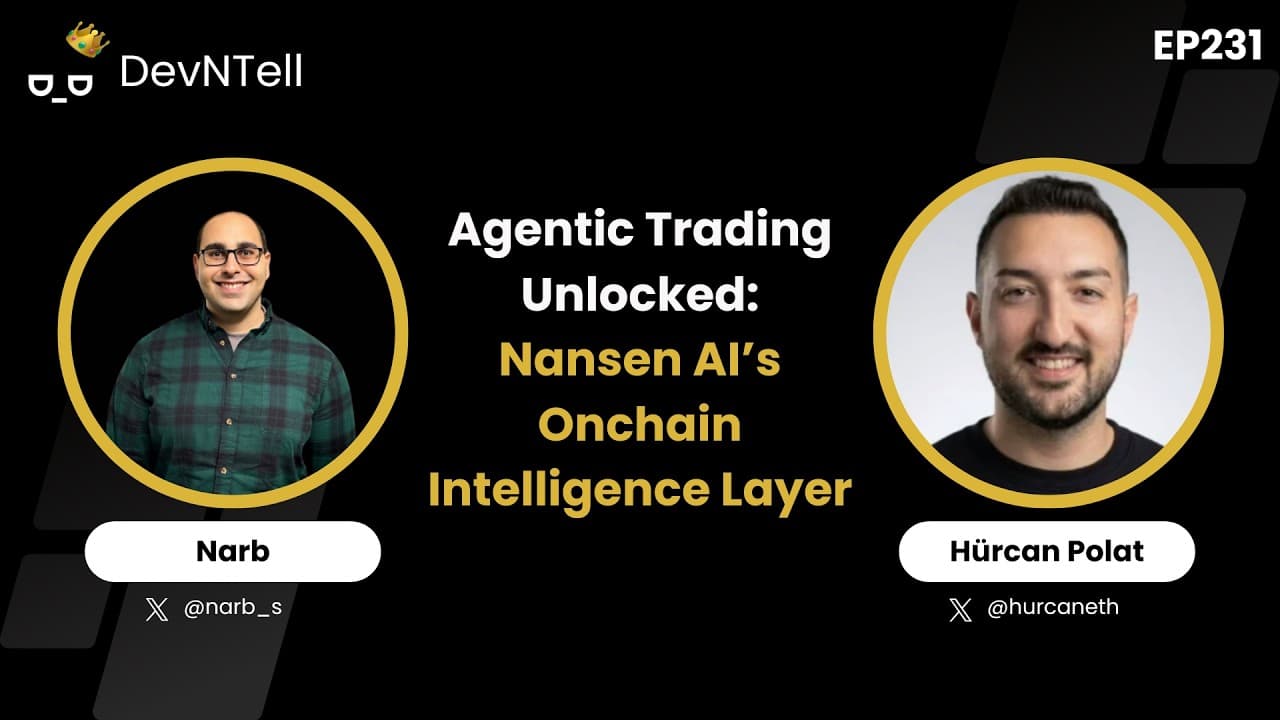
Labeling 500 Million Wallets to Bridge the Gap Between Onchain Data and AI Agents
Hürcan Polat watched the Turkish Lira slide faster than usual in 2020. He was a metallurgical and materials engineering graduate with little interest in crypto at the time, but the economic shift forced a change in focus. He spent months in Telegram groups and following traders on social media to understand the market before landing his first part-time role in the sector. By 2021, he had left his engineering career behind. After roles at the Lamden project, a data analytics firm, and a perpetual exchange, Polat joined Nansen to lead growth for developer products, where he has spent close to two years building the tools that connect raw blockchain activity to systematic users.
Listen on your favorite platform
View full episode detailsA City Phone Book Without Names
Blockchains are transparent by design, but the raw data they produce is often difficult to interpret for both humans and machines. A standard indexer can show that an address moved 500 ETH, but it cannot explain if that movement represents a significant market shift or a routine internal transfer. Nansen addresses this gap by adding labels, entities, and categories to more than 500 million wallets across more than 20 chains.
Polat uses a specific analogy to describe the difference between raw data and Nansen's intelligence layer:
You can think of raw data sources, either RPCs or indexers, as an entire city's phone book, but without any names, right? So, it's just phone numbers. You can technically call them or try to understand who they are, but it would take years of work to understand who's who. Nansen's labeled data is the same phone book, but with names, job titles, reputation scores, and credit scores attached.
For an AI agent, this context changes the nature of onchain analysis. Instead of processing a string of hexadecimal characters, an agent can recognize that a tier-1 venture fund such as Paradigm or Wintermute is rotating assets. This labeling relies on a dedicated attribution team and internal AI tools that map interconnected webs of wallets. The labels carry behavioral context, identifying if a wallet belongs to a whale, a retail investor, or a smart money participant. This historical perspective includes PnL tracking over 30 to 90 days and a record of previous counterparties, providing the breadcrumbs an agent needs to reason about the intent behind a transaction.
Laying the Rails
The progress of AI agents has accelerated since the release of models like Claude and GPT-4, which made the distinction between a simple language model and an autonomous agent clear. Large institutions have started building the infrastructure for agentic commerce, with Coinbase pushing AI-native wallets and Stripe implementing virtual payment protocols. However, the adoption of these tools for financial execution still faces a barrier of trust. Many users remain hesitant to hand real capital to an autonomous system that might misinterpret intent or fail during a critical operation.
Polat views the current phase as a period of building the necessary infrastructure before the next wave of adoption. He describes the state of the industry:
I think we are still laying the rails right now. I mean, especially since OpenAI, Claude, and other well-known AI agents came to presence, we are seeing much faster progress because now people understand how different it is to use an agent versus using an LLM, and the capabilities they have.
The goal is to move past the human-in-the-loop requirement where a person must verify every step. As models improve and hallucinations decrease, the infrastructure will be ready to handle more complex autonomous tasks. Polat compares the current AI development cycle to the early days of crypto, where new applications appeared daily and the pace of innovation was often faster than the market could absorb.
Agents Hate Subscriptions
Traditional software access relies on a subscription model that is poorly suited for autonomous agents. A typical agent does not visit a website, fill out a form, verify an email address, or manage a recurring credit card payment. This friction has led Nansen to adopt more flexible access and payment methods, including the Model Context Protocol (MCP) and a dedicated command-line interface (CLI). The CLI allows an agent to run commands and receive structured responses directly in its operating environment, while the MCP server enables tools like Claude to query Nansen data during a conversation.
To match this access, Nansen has integrated pay-per-request payment standards such as x402 and MPP. Polat has tracked the x402 protocol since its release, noting that while early volumes were likely driven by wash trading, the start of 2026 has shown a genuine increase in usage. The logic for this shift is straightforward:
Agents hate subscriptions, right? They don't go to your website, fill in their stuff, approve their email, generate their API keys through a web app or whatever. So, you have to find a way to give them an easier way of access and an easier way for paying for things.
These micropayments are typically settled in USDC on networks like Base or Solana, with costs starting as low as one cent per query. This model allows an agent to manage its own wallet and pay for only the data it consumes. While traditional REST API usage with API keys still represents the majority of Nansen's traffic, the growth in per-request payments signals a move toward a more open and agent-native economy. This competition between institutional payment routes and open-source standards like x402 will likely determine how agentic commerce scales over the next year.
Single Stop for Alpha
The roadmap for Nansen moves from providing data to enabling execution. The company recently launched trading on Hyperliquid and plans to support spot trading on Solana and Base. The objective is to create a unified experience where a user or an agent can find a signal and act on it without moving funds between different platforms. Later in 2026, this will expand to include tools for creating and backtesting trading strategies against historical data, allowing users to verify their ideas before committing capital.
Prediction markets represent another area where labeled wallet data provides a clear advantage. Nansen has already integrated Polymarket data into its API to summarize market results, but the next step involves applying smart money analysis to these markets. By identifying named wallets or likely insiders, Nansen aims to provide transparency in markets that are often moved by social media posts or privileged information. Polat points to recent examples of social platforms selling faster access to specific feeds, which can create opportunities for manipulation that are only visible when tracked onchain.
Blockchain technology provides the verifiable and trustless rails that AI agents need to manage financial decisions. Stablecoins have emerged as a primary tool in this space because they are accepted across different smart contracts and are not tied to the banking system of a single country. For Nansen, the focus remains on refining the labeling and delivery of this data so that both human traders and autonomous agents can make informed decisions in a fast-moving market.