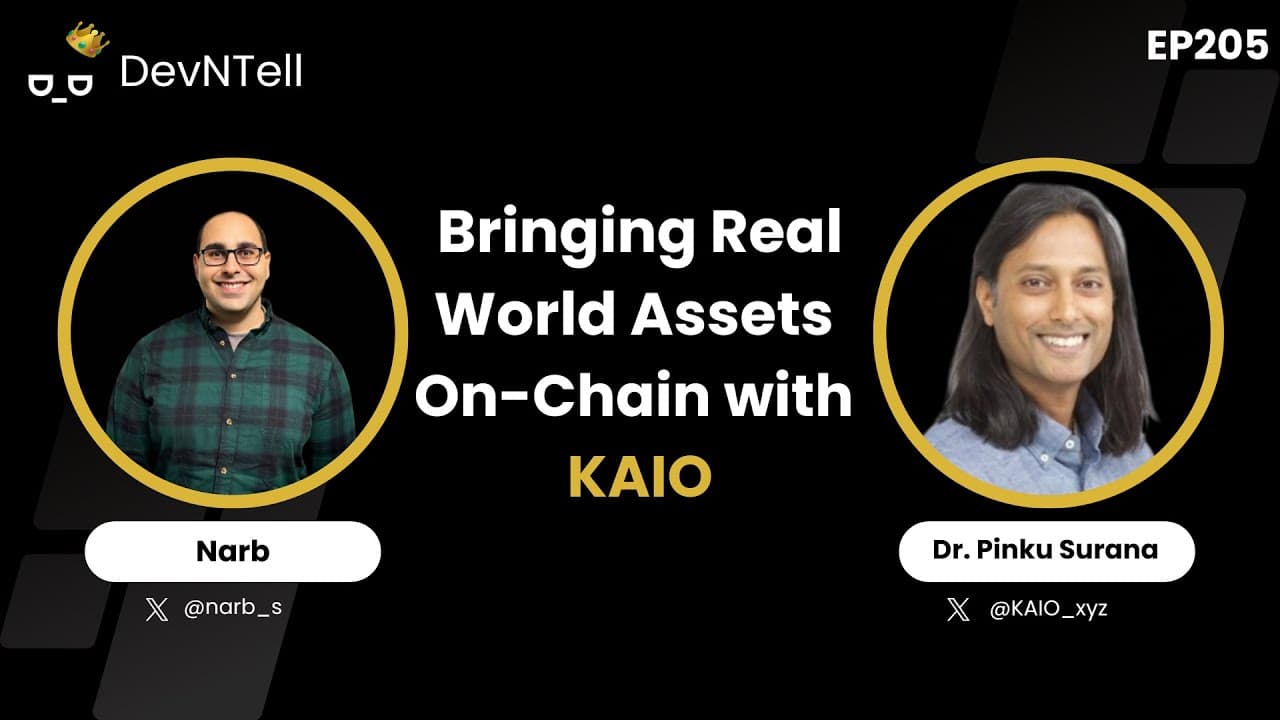
KAIO's CTO on Tokenizing Alternative Assets and the Long Road Through Regulation
Dr. Pinku Surana holds a impressive resume that includes co-founding Ondo Finance, leading blockchain research at Goldman Sachs, and training large language models on government supercomputers at Stanford. He can now also add CTO to his list of achievements as he now leads KAIO in the pursuit of tokenizing real world assets (RWA) on-chain.
Listen on your favorite platform
View full episode detailsWandering the Halls of Goldman Sachs
Surana's introduction to tokenizing real-world assets came at a company called Symbiont, where the project was to bring syndicated loans onto a blockchain. Syndicated loans involve a group of banks or investors offering a loan to a company, with specialized terms and a historically clunky coordination process involving fax machines and documents circulating for signatures. The goal at Symbiont was to find efficiencies by tokenizing these instruments.
It did not go smoothly. The technology outpaced the legal and regulatory frameworks that would have allowed it to function. That pattern followed Surana to Goldman Sachs, where he led a small research group exploring how blockchain could be applied across the bank's operations.
"I got to wander the halls of one of the world's largest banks and ask people what they do and then try to figure out, well, what would this look like tokenized? And in one of my presentations, I said that if everything at Goldman Sachs were tokenized, it would just be the CEO and I wandering the empty halls while blockchains just ran everything autonomously."
The vision was technically achievable in outline, but the legal and regulatory hurdles were, in his words, "enormous." Goldman's lawyers were cautious, for understandable reasons. That caution eventually pushed Surana toward a startup environment. He co-founded Ondo Finance, where moving fast to bring products to market was possible precisely because it was not a large bank. Ondo Finance has since become one of the more visible names in the tokenized asset space.
Between Ondo and KAIO, Surana spent time at Facebook on AI and then at Stanford using government supercomputers to train large language models, collaborating with NVIDIA Research and several universities. He describes himself as someone drawn to the bleeding edge of whatever technology wave is currently building. What pulled him back to real-world assets was not nostalgia but a specific read on the regulatory environment.
The Regulatory Opening
The stablecoin market, in Surana's view, is the indicator to watch. Once regulators move on stablecoins, the path opens for more complex tokenized assets higher up the stack. He points to JP Morgan's active unit in the space and BlackRock's Larry Fink, who has been publicly vocal about tokenizing traditional financial instruments, as signals that institutional appetite is real. But Surana is not overstating the progress.
"I think there is still a long way to go," he said. "There are problems with how regulations are always centered around some country, but blockchains are global. And so this adds this weird layer of complexity where you say, well, I have this product, but I can only offer it to certain people who have certain characteristics."
Those characteristics include country of origin, accredited investor status, and sanctions screening. Smart contracts operating across global networks do not naturally accommodate jurisdiction-specific rules. That gap between what the technology can do and what the regulatory environment permits has been the defining friction in Surana's career, and it is the problem KAIO is trying to address directly.
Alternative Assets for the Masses
The core pitch for KAIO starts with a line Surana attributes to Bloomberg financial writer Matt Levine: private markets are the new public markets. The argument is that public equity markets are shrinking while private markets have grown large enough that companies like SpaceX can raise all the capital they need without an IPO. For most investors, that means those assets are simply out of reach.
Access to private credit funds, sports team ownership funds, and other alternative assets typically requires a private wealth account at a major bank, with a minimum of ten million dollars in investable assets just to begin a conversation. The funds themselves often carry minimum investment sizes, restricted withdrawal windows, and approval processes for when redemptions are allowed.
Surana describes having had personal access to a fund offering shares in sports teams across football, basketball, hockey, and soccer leagues, but only because of his own financial position. The broader class of investors with assets between two and ten million dollars has no equivalent access. KAIO's stated goal is to change that by lowering minimum investment sizes and making it easier to enter and exit these funds through tokenization.
The mechanics follow a familiar structure for tokenized funds: real-world assets are held in a custodial account and matched one-to-one with tokens on chain. What KAIO has built differently is the encoding of regulatory rules directly into the smart contracts rather than managing them through off-chain processes. When a DeFi protocol interacts with a KAIO token, the smart contract already knows the rules about who can hold it, when redemptions are allowed, and what transfers are permitted. There is no delay waiting for an off-chain system to confirm eligibility. Surana describes this as the primary technical distinction from competitors, one that enables greater DeFi composability.
Encoding the Rules On Chain
The institutional product is already live, allowing funds to tokenize their assets and make them available to accredited investors through KAIO's web app. The next step is a retail product called Cash, described as an index fund token that packages several alternative asset products together. Because it is structured as an index fund, it can be offered to retail investors without requiring accredited investor status, which sidesteps one of the major regulatory barriers. A waitlist for early access was described as opening within a week of the recording.
APIs are also in development at two levels. One set targets institutional fund dealers who want to integrate KAIO's on-chain services into their own internal systems. The other targets developers building products that could distribute the Cash token across different platforms and applications. Surana framed the retail API as the more accessible entry point for developers in the DeFi space, with the Cash token serving as the primary distribution vehicle once it launches.
Build Something People Want
When asked for advice aimed at aspiring founders, Surana kept it short. "You build something people want. And that's about it." He pointed to Y Combinator's public library of essays and videos as a resource that states this simply, and noted that the AI space in particular is full of people who have a technology and are working backward to find a problem for it, without a specific customer or genuine demand in mind.
The observation connects directly to how Surana framed his own return to the RWA space. He had been looking at alternative asset funds that interested him personally, finding them complicated, restrictive, and inaccessible at his level of capital. When KAIO came looking for a CTO, the problem the company was solving was one he had already encountered firsthand.