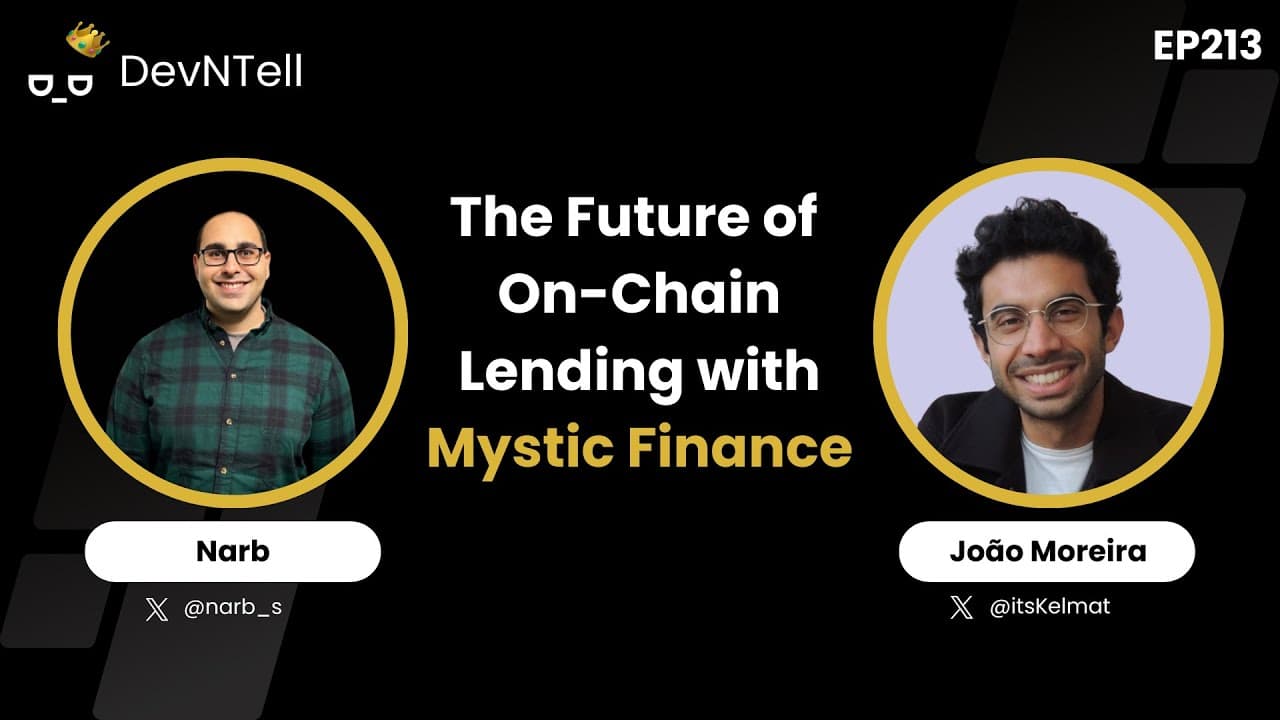
João Moreira on Why RWA Lending Breaks Without Secondary Markets
RWA total value locked climbed from around $5 billion to $35 billion over roughly a year and a half. That shift is part of what João Moreira, founder and CEO of Mystic Finance, points to when explaining why he walked away from NFT-based infrastructure in early 2024 to ask a more uncomfortable question: was he actually building on anything real?
Listen on your favorite platform
View full episode detailsFrom an NFT OTC Desk to First Principles
João is from Lisbon, Portugal, and came to crypto the same way many people did in 2021: through NFTs. Before that, he had taught himself to code while co-founding an AI startup in 2020, a period he describes as "pre-LLM era, so no fast-tracking our way around it." From there he moved into private equity for SaaS businesses, eventually becoming CEO of a company his firm had acquired. Then came NFTs, and then an observation that stuck: there was no clean way to do a direct OTC swap of one NFT for another without routing through a moderator. He built an NFT OTC desk to solve that, and the product became his entry point into crypto as a builder.
After the OTC desk, he and his team moved into gaming NFT marketplace infrastructure. Both efforts shared a structural problem: they were dependent on NFT valuations. When those valuations did not hold, neither did the business case. By early 2024, João had decided to step back entirely.
"I was really not building on fundamentals. I should be more first-principles about how I go. I guess I was chasing fads without even realizing it, really."
The question he landed on was simple: what would exist and matter in five to ten years? His answer was that lending and credit are foundational to how money moves in the world, and that tokenized real-world assets were going to be the next meaningful product-market fit in crypto after stablecoins. That assumption sent him toward building Mystic Finance.
The Flash Loan Problem
The technical challenge at the center of RWA lending is less about the lending infrastructure itself and more about what happens when things go wrong. In a standard DeFi liquidation, a liquidator borrows from the lending market, pays off the debt, then swaps the collateral for the borrowed asset through a DEX using AMM liquidity. The whole cycle can close in a single block through a flash loan.
RWAs break this model. Most tokenized securities are permissioned, which means they cannot be freely swapped on an AMM. Many are structured as tokenized funds with redemption features, which means issuers have less incentive to build out secondary market liquidity when users can always redeem for stablecoins through the fund itself. The result is that most RWAs, as João put it, "don't have any AMM liquidity to speak of."
"The problem we wound up realizing is we need to be able to liquidate these assets predictably, otherwise you can't onboard them as collateral in lending. That was ultimately the problem we found that we were experiencing on Plume. We were having difficulties scaling our Morpho vaults unless we could find predictable liquidation paths."
Mystic Finance originally committed to building the native lending market on Plume, a Layer 1 chain focused on RWAs. The team also became the front end for Morpho on Plume, building on the Morpho stack and working closely within that ecosystem. It was through operating those vaults that the secondary liquidity gap became concrete rather than theoretical.
Building Octarine
Mystic Finance currently runs at mysticfinance.xyz as a Morpho-based lending UI. The product has found a specific niche on emerging EVM chains where Morpho does not have a dedicated front end, and João says it has "active users pretty much every single minute."
The newer product is Octarine Finance. Its core mechanism addresses the secondary market problem directly. When a user wants to exit an RWA position without waiting through the asset's standard redemption period, Octarine auctions that request to liquidity providers. An LP willing to underwrite the duration risk buys the user's asset at a discount, redeems it through the standard process, and keeps the spread as yield. The user gets immediate liquidity; the LP gets access to deal flow with a built-in return.
A second version of Octarine is designed to go further. Rather than Mystic running the facility itself, V2 would let issuers, curators, and protocols stand up their own RWA secondary market vaults. The goal is to make it possible for any lending market to self-service the secondary liquidity problem. João frames the distinction from competitors plainly: "We are the only ones sourcing it fully on-chain. We're really trying to build a Lego piece that fits into the rest of the ecosystem, whereas I would say that competitors are taking a more maybe monolithic approach."
For developers, Mystic already fields requests for API access to lending data from teams building liquidation bots and position-tracking tools on emerging EVM chains. Octarine is positioned as something closer to a plugin, designed to be composed into existing lending markets or DEX interfaces that want to add support for RWA collateral.
Your Surface Area of Luck
João was asked what he would tell someone on the verge of starting a company, and he returned to the same first-principles framing that led him to Mystic. Chasing short-term noise in crypto is easy, he said, because the environment changes fast and attention moves constantly. What matters is identifying the underlying assumptions that are durable and building toward those.
On resilience, he was direct:
"You need to stay in the market long enough to quote-unquote be lucky and find the right opportunity. And that in my eyes means you can't be looking at the opportunity cost. You should think of yourself as a missionary, not a mercenary. You're doing this because you really want to do it and there is no money to substitute that want."
He credited a founder friend for a phrase he uses to think about probability over time: "surface area of luck," meaning the more shots at the goal a builder takes, the more likely one connects. The math only works if the builder stays in the game long enough to collect those chances.
Octarine's V1 was described as launching within three to four weeks of the recording. Whether the auction mechanism holds up under actual RWA liquidation pressure, and whether issuers adopt the V2 vault infrastructure João described, are questions the product will have to answer in practice. The underlying bet is that predictable secondary market liquidity is the missing layer between where RWA lending stands today and where it needs to go.