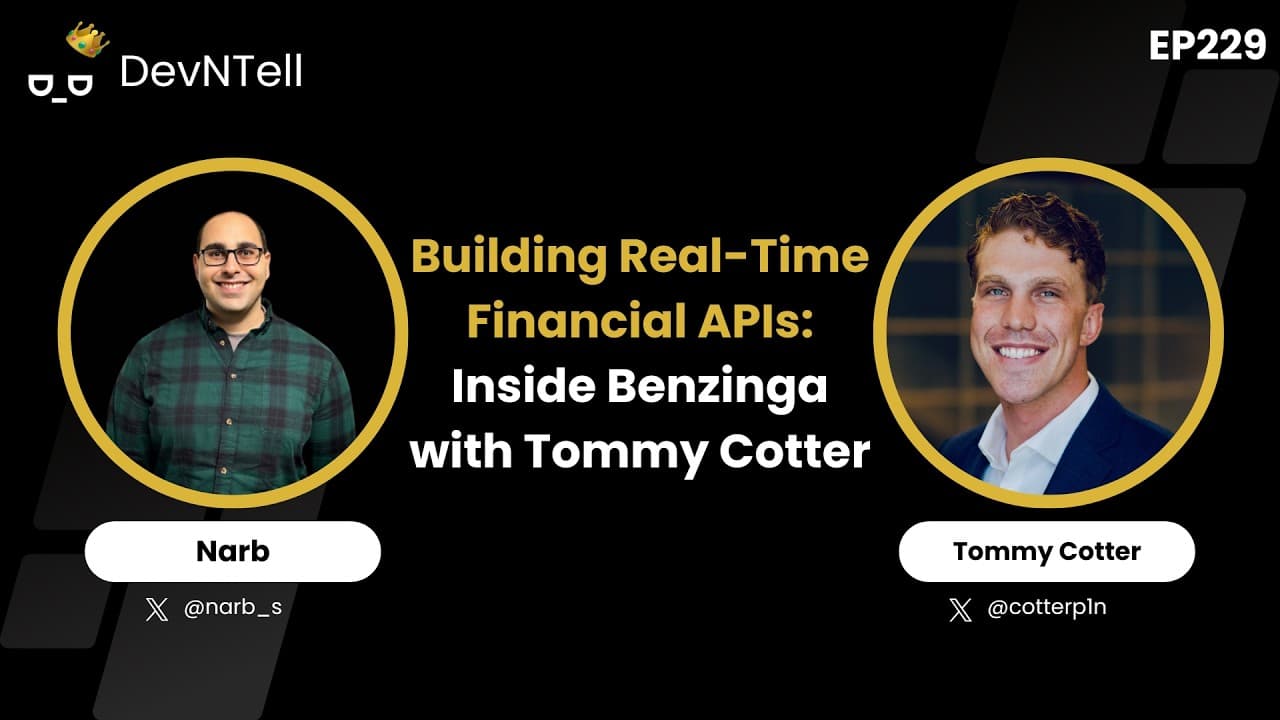
Inside Benizinga and the Shift Toward Agentic Finance
Tommy Cotter put fifty dollars on a virtual card and let an AI agent make his first trade with it. Robinhood had just released its Model Context Protocol integration, and Cotter, the Director of Data Products at Benzinga, connected it to Claude and executed a trade without leaving the chat window. "I placed my first trade a few weeks ago when they released it, and I thought that was fascinating," he said. He plans to put in more than fifty dollars next time. This specific interaction represents a shift in how financial transactions occur, moving away from traditional brokerage interfaces toward systems where the user simply tells a machine what they want to happen.
Listen on your favorite platform
View full episode detailsCotter did not start in finance or software. He studied mechanical engineering at Oakland University in Metro Detroit, which he is careful to distinguish from Oakland, California. He went there to play basketball, and after college he did what many students in the area do and took a job in the automotive industry. He worked for Fiat Chrysler for a couple of years before and during the pandemic. His route into technology came through a single introduction when he met the Vice President of Licensing at Benzinga, who was looking for help on the product side. "The rest is history," Cotter said.
From Fiat Chrysler to Financial APIs
Benzinga is a financial media company that writes stock market news for retail investors, but alongside the news it has built a suite of more than thirty API products. Cotter frames the company as small next to the data licensing shops it sells against, names like Refinitiv, S&P Global, and FactSet. Those conglomerates run data teams in the tens of thousands of people, and they still do. The difference now is speed. A company the size of Benzinga can compete because it can ship an AI product quickly instead of throwing an army of analysts at the problem.
And what's interesting and unique is that a small company like Benzinga, I say we're small relatively to some of the other players, but we can go out and compete because if we're able to innovate quickly with an AI product, we can compete against the likes of those conglomerates.
That framing runs through the products he is most excited about, and the clearest example is the one built on earnings calls. Historically, these calls were transcribed by humans or simple speech to text engines that struggled with financial terminology and speaker identification. The integration of large language models has allowed for a much cleaner and more useful output for the end user. Accuracy and speed are the two primary metrics in the financial news space, and by using AI to automate the collection and processing of data, a lean team can match the output of much larger competitors.
The Two Second TS Files
Every quarter, public companies host earnings conference calls where executives sit with their investor relations team and the analysts covering the company and walk through their financials. The calls run over an hour, which Cotter points out is not feasible for a busy person to sit through. Benzinga's conference call transcripts endpoint transcribes the audio, summarizes it, and makes the result available inside a brokerage account after the call. The system allows a user to log into their account and see a summary or a live stream of the conversation as it happens.
The mechanics of the system rely on an HTTP Live Streaming, or HLS, stream. The audio from the conference call is broken down into small files, specifically .ts files that are typically two seconds in length. The system takes these individual files and transcribes them, outputting a short utterance. These utterances are then sent through a websocket as a JSON object, appearing as a few words at a time. This allows developers to build interfaces that stream the transcript to users with minimal latency.
"It's pretty simple to throw an audio file at any decent audio model and get some decent text quality in response," Cotter said of building the feature. There are two transcript versions in the response. One is the live real-time transcript. The other is post-processed, cleaned up by a large language model and formatted for punctuation, then broken into segments with each speaker, start time, end time, and text. Benzinga applies sentiment to each segment, which opens up things like shading or highlighting the text.
The MCP That Is Not Quite an MCP Yet
Getting started is meant to be self-service. Anyone can go to the documentation site, open the dashboard, spin up a key, and start hitting endpoints without talking to a salesperson for two weeks. Pricing and production use come later, once Benzinga understands the use case. The self-service model is designed to allow developers to start building immediately without waiting for lengthy sales cycles. Exploration is cheap and immediate, but commercial deployment is where the company wants more context.
The agentic side is less finished. Asked whether Benzinga has its own Model Context Protocol server like the Robinhood one Cotter used, he was direct about the gap.
Yeah, we don't, we kind of have an MCP, but it's not like a true MCP server that you can really hook into Claude in a simple way like most MCPs are. We get a lot of our requests from the enterprises, and it just hasn't gotten there yet.
For Benzinga's datasets, an MCP would mostly be a wrapper around the existing API, though he acknowledged an MCP could go further and build a workflow that hits several endpoints to surface data for a specific tool. Demand from enterprise clients has stayed focused on the APIs themselves, so the server has not been a priority. Even so, he expects to have something ready by the end of summer. The rise of AI agents is creating a new category of consumers for financial data, and while human developers have traditionally been the primary users, the industry is moving toward a model where agents purchase and consume data autonomously.