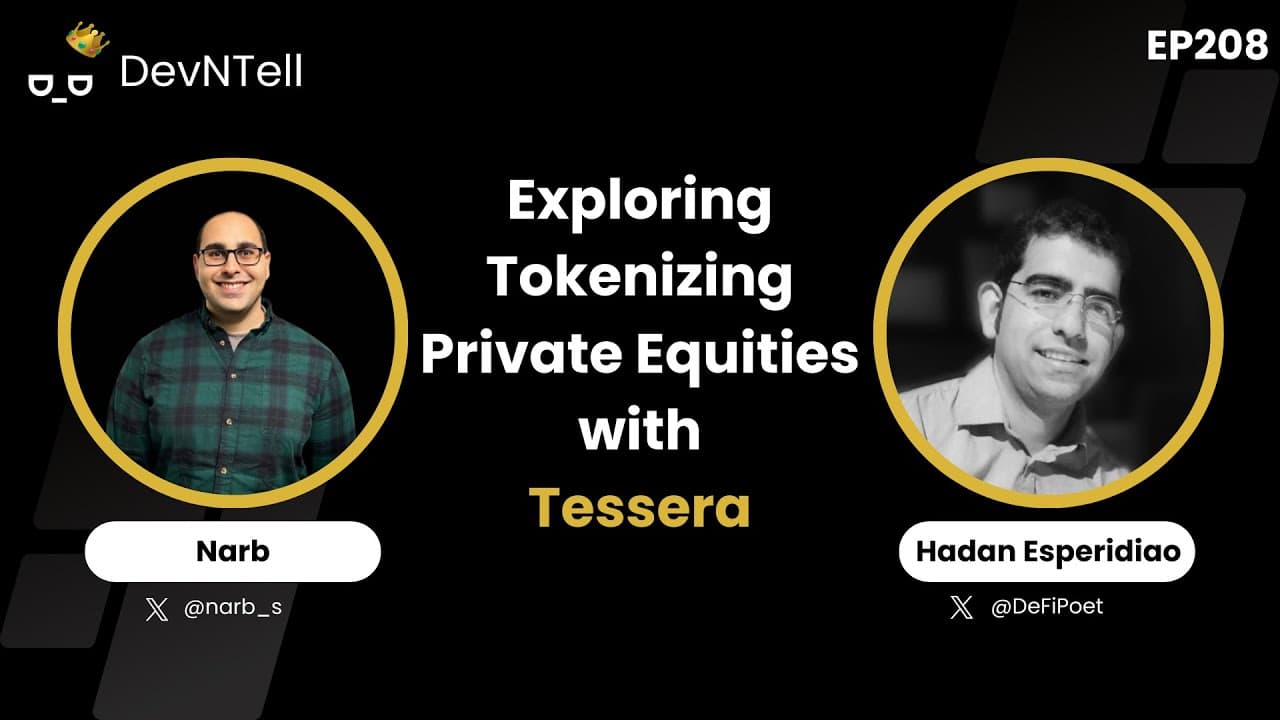
How Tessera Is Bringing Tokenized Private Equity to Anyone With a Crypto Wallet
When Google wrote SpaceX a $900 million check at a $12 billion valuation, most people were not invited to participate. If SpaceX goes public at the 1.5 to 1.6 trillion dollar range being widely discussed, that single check turns into a return of over 100x. Hadan Esperidiao, Community Lead at Tessera, used that example to describe what the platform is actually building against: not just a market gap, but a structural exclusion. "You were never allowed in," he said. "You've been locked out by design."
Listen on your favorite platform
View full episode detailsAll the Sevens Lined Up
Esperidiao came to Tessera through a specific combination of background and timing. He studied physics at Harvard, then spent roughly a decade on the sales and trading desk at Goldman Sachs, working in structured products. He left investment banking around the time DeFi started coming online, initially as a community member and trader before joining projects in the Bitcoin DeFi space starting around 2020. Real World Assets had been a long-standing conviction for him well before they attracted wider attention. When Tessera approached him about applying RWA tokenization specifically to private equity, he described the moment this way:
"When Tessera kind of approached me that, uh, private equity RWAs, then, you know, kind of like all the sevens lined up on the slot machine, and I was like, I've got to be a part of this."
His framing of where crypto is heading centers on the idea that on-chain infrastructure was always building toward something larger than collectibles or meme coins. He pointed to roughly $20 billion in RWA market cap as of 2024, noting that approximately $19 billion of that sits in treasuries and private credit. Equities represent around $800 million of the total, and private equities are effectively new territory.
Locked Out by Design
The legal architecture around private equity in the United States emerged from the post-1929 regulatory environment. Accessing shares in private companies before an IPO typically requires accredited investor status, which in practice means a net worth of at least $1 million excluding a primary residence, or annual income in the range of $200,000 to $300,000. Beyond the qualification threshold, investors are writing minimum six-figure checks and committing to lock-up periods that can stretch across multiple years. That structure excludes, by Esperidiao's estimate, roughly 99% of the population from any meaningful private equity exposure.
The companies generating the most attention right now, SpaceX, OpenAI, Kalshi, Polymarket, are all private. Reading about them daily while being structurally barred from holding any position in them was something Esperidiao described as a kind of conditioning: "It's wild how we've been conditioned to be passive about the fact that you can't just go out and have exposure to these things you feel so bullish on."
Tessera's answer to that is permissionless tokenization on Solana. The platform acquires positions in private companies, holds the shares in portfolio-segregated entities (companies that exist solely to hold the underlying shares), has those positions independently audited, and then issues tokens that trade freely on-chain.
T-SpaceX Live on Meteora
Tessera launched its first alpha vault on February 12th, bringing SpaceX exposure on-chain through a token called T-SpaceX. At the time of recording, T-SpaceX was live and trading on Meteora. The mechanism works in two directions: a trader who wants to move quickly can buy or sell T-SpaceX on the open market at any time. A trader who wants to hold through an eventual IPO can wait for the redemption window, at which point Tessera burns the tokens and distributes stablecoins based on the exit value of the underlying position.
Kalshi is identified as the next token in the pipeline. Esperidiao said the selection criteria at this early stage center on brand recognition, community demand, and companies that appear likely to IPO within a 12 to 24-month window. The near-term IPO horizon matters because it gives early users a chance to observe the full redemption cycle, from token purchase through the burn-and-receive-stablecoin process, while the companies being tokenized are ones that generate genuine market interest.
The choice to build on Solana first reflects both infrastructure considerations and community fit. Low fees, fast settlement, and a trading-active user base were factors Esperidiao cited, along with the Solana Foundation having identified internet capital markets as a priority area. Tessera has described a multi-chain vision over the medium to long term, but the current focus remains on Solana.
Proof of Reserve Through Chainlink
On the transparency side, Tessera feeds its independent audits through Chainlink Proof of Reserve, providing on-chain verification that each token has one-to-one backing in actual shares held. Token minting, burning, and creation are handled through Fireblocks. There is no KYC at any point on the platform, including at the redemption and cash-out stage, which Esperidiao identified as a deliberate design choice and a differentiator from comparable products.
The referral structure is built directly into the token standard. Thirty-five percent of protocol revenue flows to a referral network, with 30% going directly to the referring user, 3% to second-level referrals, and 2% to third-level referrals. Esperidiao framed this as a mechanism for rewarding early participants as the platform scales.
On AI integration, Tessera has already applied AI tooling to internal workflows, FAQ systems, and Telegram support. Looking further out, Esperidiao mentioned that the team is building an MCP (Model Context Protocol) version of the Tessera website designed specifically for bots to browse, scrape, and interact with the platform programmatically, so that AI agents can retrieve accurate information and potentially execute trades directly.
The Google-to-SpaceX return story Esperidiao told was not presented as a pitch for any particular investment outcome. It was an illustration of what has historically been gated. Whether or not the specific IPO timelines materialize as discussed, the underlying structure Tessera is operating against, private equity as an asset class that retail participants cannot access through conventional brokerage accounts, is the actual problem the platform was built to address.