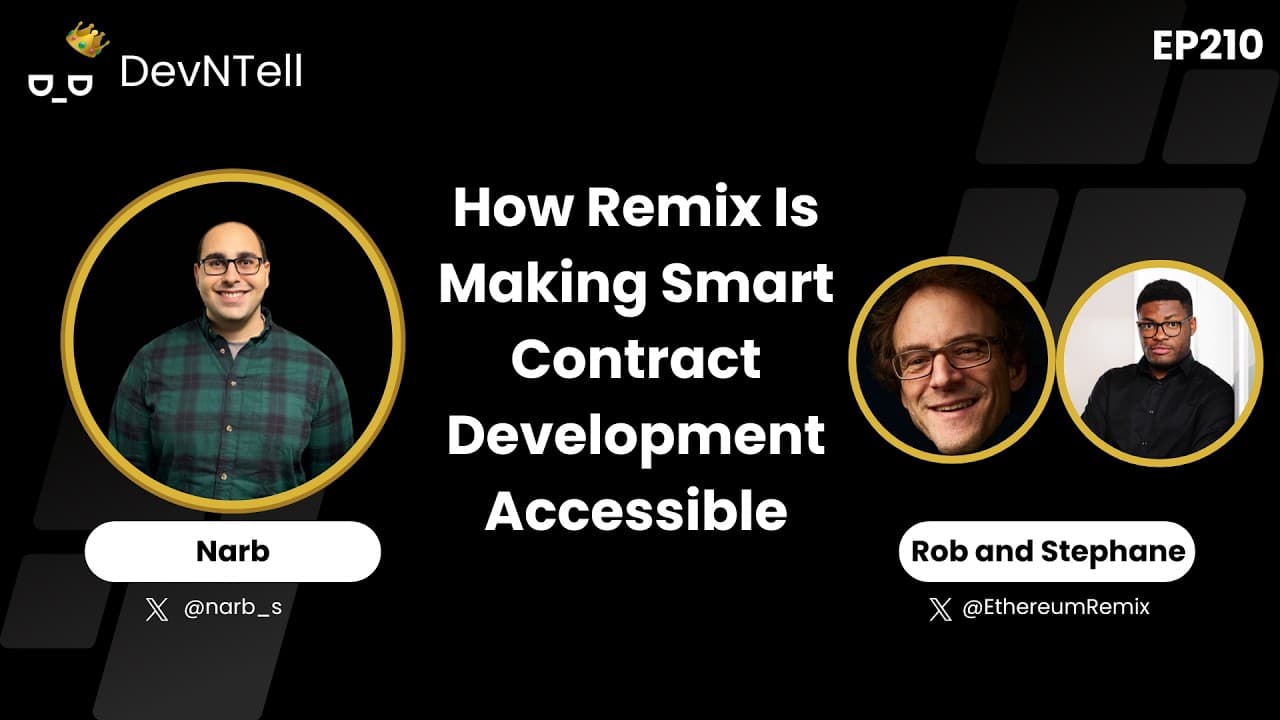
How Remix Is Moving on from the Ethereum Foundation and Betting on AI-Assisted Smart Contract Development
Rob Stupay took a class at MIT called Telecommunications for Artists sometime in the mid-2010s. One of his classmates eventually ended up as head of the Ethereum Foundation. That connection, plus a job offer, pulled Stupay into the Ethereum ecosystem, and he has been at Remix ever since, watching the tool grow from a straightforward compiler into something considerably more complex. "I've been there since 2017," he said. "Remix has been going for a long time."
Listen on your favorite platform
View full episode detailsThat longevity matters because Remix is in the middle of a significant transition. The project operated under the Ethereum Foundation umbrella until July, when it became independent. With independence comes the need to generate revenue, which is driving a new product direction built around user accounts, cloud storage, and a set of AI features that Stupay and his colleague Stephane Tetsing walked through in detail.
Moving on from the Ethereum Foundation
For most of its existence, Remix had the backing of the Ethereum Foundation, which meant the project could operate without its own revenue model. That changed last July.
"We were an Ethereum Foundation project until July. And so now we're on our own. And so that means that we have to find some funding." -- Rob Stupay
The answer is Remix Pro, a paid tier sitting alongside the free version. Pro accounts will include cloud storage for workspaces, preserved prompt histories, expanded model context protocol (MCP) integrations, more choices for the underlying language model, and access to the AI-assisted front-end builder. The team was actively recruiting beta testers at the time of the recording, with a signup form planned for shortly after. The beta itself was expected to go live within a week of the episode airing.
You Don't Have to Install Anything
For developers who have not used Remix, the core appeal is straightforward. Setting up a local smart contract development environment typically means installing a significant stack of dependencies before writing a single line of Solidity. Remix eliminates that step by running as an online IDE.
Tetsing described it plainly: "You don't have to install a lot of tools. It's just bring up your contract, select the chain where you want to deploy a contract on, and then you are good to go."
Stupay added that many projects actively link to Remix so clients or collaborators can deploy contracts or inspect a project without any local setup. The tool supports the full range of standard blockchain operations, including writing and compiling contracts, deploying to test networks or mainnet through a connected browser wallet, and stepping through transactions in the debugger. That breadth has made it a common entry point for developers learning Solidity, as well as a prototyping tool for more experienced teams. The updated beta release also includes a redesigned deploy-and-run panel and a debugger with more screen space, with the gas usage per line and stack view still present but reorganized.
Vibe Coding Wasn't Here Two, Three Years Ago
The AI features in the upcoming release reflect a shift in how developers are actually working. Stupay was direct about the change: "These days with AI, the whole developer workflow is changing. Vibe coding wasn't here two, three years ago."
Tetsing, who came to Remix from a traditional machine learning background after meeting the project's head, Yann, through playing music together, has been building the AI layer over the past two and a half years. The most ambitious feature is what he described as "a one-prompt solution." A developer can type a description of what they want, and Remix generates the contract, compiles it, checks it for vulnerabilities, deploys it to the specified chain, and produces a front-end interface for interacting with it, all without writing any code manually.
During the live demo, Tetsing walked through a prompt asking for an ERC20 token capped at ten holders with a maximum of forty mintable tokens. The AI generated a workspace containing a compilable contract, then deployed it to the Remix virtual machine. He noted that the same workflow can connect to a browser wallet like MetaMask and deploy to a public testnet or mainnet with minimal additional steps, and that the tool supports any browser-based wallet through WalletConnect as well.
The front-end builder, which Stupay demonstrated through a recorded walkthrough, produces a hosted dapp deployed to IPFS through Pinata, with a custom subdomain under a Remix-owned domain. Stupay also mentioned that the builder can produce Base mini-apps, with a registration process that moves between the Base app environment and Remix. An uploaded image or Figma file can serve as the basis for the design.
MCP Integrations and Blockchain Queries
One of the more technically specific additions in the beta release is a set of MCP integrations that let the AI assistant query live blockchain data. The current integrations include the Graph, the Graph's Amp database, and Alchemy.
Tetsing demonstrated a query asking which NFTs a specific Ethereum mainnet address holds. Without any manual API configuration, the assistant returned a list of holdings. "With a simple prompt from the Remix environment, you can actually query the blockchain without even having to go to any specific provider," he said. The point he made was that tools like Claude Code do not carry that kind of live blockchain connectivity, which gives the Remix assistant a distinct surface area for on-chain questions.
Cloud storage, once user accounts launch after the beta period, will preserve both workspaces and prompt histories across sessions and devices, so a developer who switches computers can return to a previous AI conversation without losing context.
Tetsing closed the session with a brief mention of a feature still in development: a copilot that would adapt to a developer's existing knowledge level and pace, going deeper than the Learneth tutorials already embedded in the IDE. Both he and Stupay agreed it was too early to show publicly. Stupay pointed beginners in the meantime toward the Patrick Collins video series and the Smart Contract Programmer channel on YouTube, along with the "Start Learning" button on the Remix homepage, as places to get started with Solidity before the copilot feature arrives.