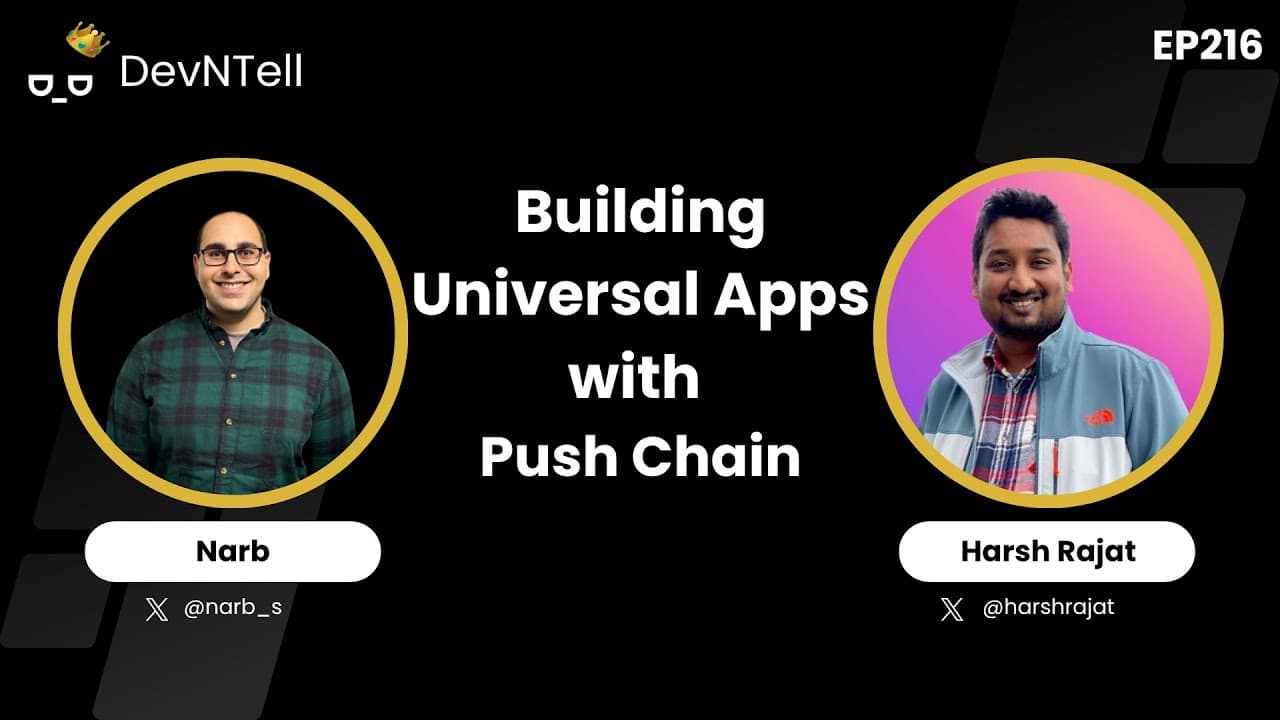
How a Liquidated DeFi Loan Led Harsh Rajat to Build a Universal Blockchain
In 2019, Harsh Rajat stepped away from a DeFi lending protocol for about a week. When he came back, his loan had been liquidated. There was no alert, no notification, nothing. That moment of frustration set off a chain of events that eventually led to Push, a Web3 communication protocol that grew from a hackathon project into what Rajat now describes as a universal settlement layer for every blockchain.
Listen on your favorite platform
View full episode detailsBuy High Sell Low, Ask Me
Rajat's path into technology started before crypto was a household word. Growing up in India, he noticed early on that the mobile browser experience was lacking when the iPhone launched. That instinct led him to build a power browser that reached the top 10 in the US App Store. Games followed, then experimentation with AI and machine learning around 2013.
Bitcoin entered the picture in 2016. Rajat bought in at $1,000, watched it fall to $200, and summarized the experience with characteristic directness: "Buy high sell low, ask me, I have really useful tips." What came next was more instructive. He noticed price differences between European and Asian exchanges and built an arbitrage bot to take advantage of them. That bot ran profitably until other traders caught on around 2018. By then, he had encountered ERC-20 tokens and started learning about Ethereum.
The 2019 liquidation was the turning point. Rajat knew from his mobile background that notification systems were technically achievable, so he wrote up an architecture proposal and sent it to the Ethereum Foundation, pitching notifications as a feature of Ethereum itself. The Foundation declined to fund it but encouraged him to build it at ETHGlobal. At that hackathon, Push delivered its first Web3 notification, and the early support from the Ethereum community gave the project its foundation.
A Joke That Turned Ugly
By 2024, Push had established itself as a leading Web3 communication platform, handling notifications and chat. The plan was to connect every blockchain layer. That meant deploying the protocol on Polygon, then Solana, then whatever came next. Rajat described what that process actually looked like for an engineering team: rewriting smart contracts for each new chain, hiring Rust developers for Solana, paying for multiple audits, and then building sync management infrastructure on top of all that.
"What we realized was that this is not a easy feat for a Web3 developer. Because your smart contract, you have to rewrite that for a different blockchain like Polygon. If Solana then you have to hire someone who knows Rust, getting engineering, bloating your engineering team, and of course the audit cost, that just compounds."
At some point during one of those multi-chain deployments, someone on the team threw out a joke: why not just build a universal chain? The more chains Push launched on, the less funny the joke became. Eventually Rajat decided to stop treating interoperability as a deployment problem and start treating it as an infrastructure problem. Push Chain was the result.
The Interop Trilemma
The framing Rajat uses for what Push Chain solves is what he calls the "interop trilemma." The generation of interoperability protocols that came before, he argues, were fundamentally passing messages from one chain to another. But that is not what a user actually wants. A user wants to use an app on another chain. The message-passing approach puts the burden back on either the user (figure out the bridge yourself) or the developer (build a middleware contract). Push Chain's answer is a unified settlement layer that sits beneath all of those chains.
The mechanics work through what Rajat calls a universal executor account. When a Solana user comes to a Push Chain app for the first time, the chain deploys a smart account for that user. That smart account verifies the user's Solana signature using the ED25519 algorithm and only executes instructions that the origin Solana wallet has authorized. Gas funding happens through gateway contracts deployed on each supported chain. A user pays in their native token, the Push Chain validators detect that, mint an equivalent in P-ETH, swap it to PC, and attribute it to the user's smart account.
During the live demonstration, Rajat showed this in action using a simple counter contract. A Solana wallet connected, signed one transaction, and a green ball dropped on a universal leaderboard alongside balls from Ethereum and other chains, all interacting with the same EVM contract on Push Chain. "This Solana user never left Solana," Rajat noted. "They basically used their Solana wallet to control the entire experience."
The same architecture extends further. A controlled executor account on an external chain can be owned by a universal executor account on Push Chain, which is in turn controlled by a wallet on any origin chain. That means a developer building a universal yield product could, in a single transaction, pull funds from an Aave position on Polygon and route them to Jupiter on Solana.
Getting Started with the SDKs
For developers, Rajat walked through the two SDKs needed to make an existing app universal. The first is the UI Kit, which provides an embeddable wallet and account button. The second is the core SDK, which handles the transaction layer.
Because Push Chain is fully EVM-compatible, smart contracts deployed on it require no changes. The on-chain side of a migration is just a deployment. On the front-end, developers wrap their wallet and account button with the UI Kit, then replace any existing sendTransaction calls with universal.sendTransaction. For developers who want cross-chain execution beyond Push Chain itself, the core SDK accepts a to.chain parameter that routes the transaction to an external chain through the controlled executor account system. Rajat also pointed to live playgrounds embedded directly in the documentation at push.org/docs/chain as the fastest way to test without installing anything locally.
Build in Public, Start at a Hackathon
Rajat offered three pieces of advice for developers thinking about starting a project in Web3. The first was to ask questions without hesitation, on the grounds that most people in the space genuinely want to help. The second was to build in public, even when the instinct is to protect an idea.
"Ideas they might be worth a million, but execution is worth a billion. Someone can copy your 140 character tweet. They cannot copy the thought process of thousands of hours that you have spent towards your idea."
The third was to start at a hackathon. Rajat pointed to ETHGlobal as the place where Push was born, but his reasoning was less about prize money and more about the conversations that happen between developers at those events, the kind of passing mentions of tools like Tenderly or Hardhat that materially change how fast a team can build.
Season 3 of Push Chain's portal program was launching around the time of recording, accessible at portal.push.org on an invite basis. Rajat told DevNTell viewers that the first ten people to DM him the word "DevNTell" would receive an invite code.