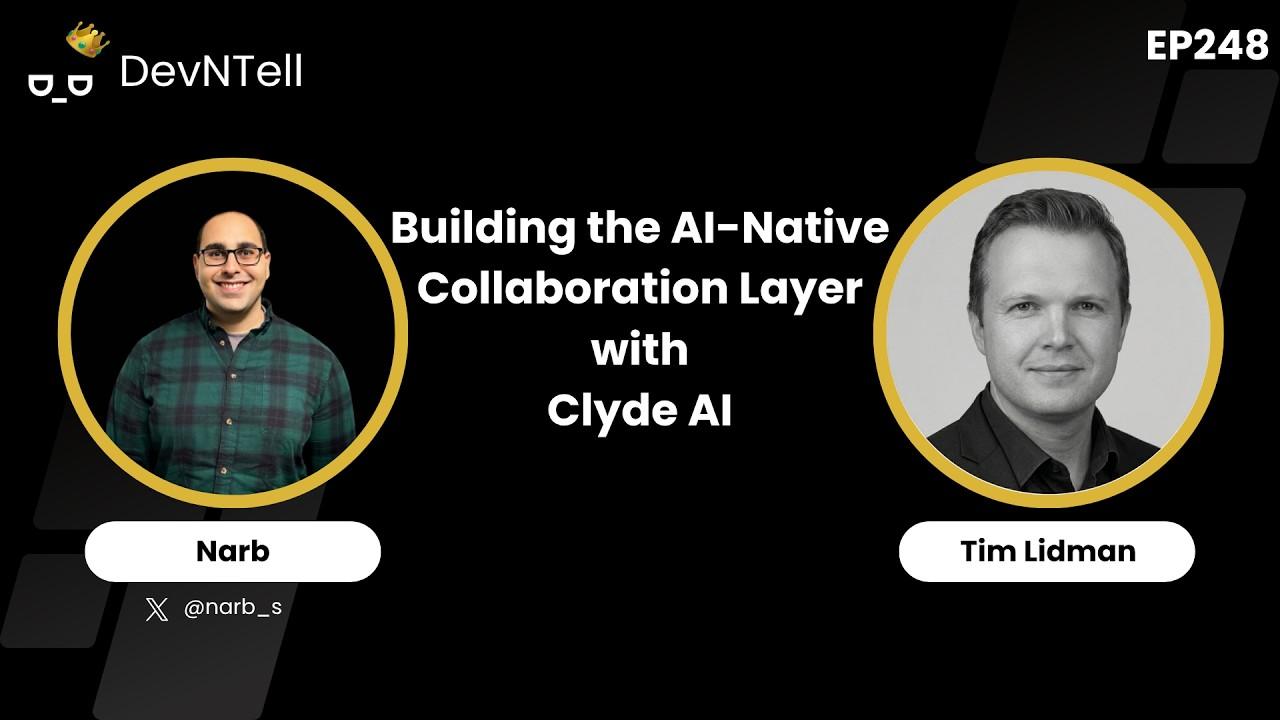
From Heavy Metal Drummer to Consulting AI: Tim Lidman on Building Clyde
Tim Lidman's rent in London was higher than his pub job paid. He had moved there from Sweden as a long-haired heavy metal drummer who wanted to be a rock star. When the money ran short, a couple of people he met suggested he might be good at selling software. His first job in tech was trying to convince people to meet on audio conferences instead of in person. Today he is co-founder and CEO of Clyde AI, a Denver-based company building what it calls an AI-native collaboration platform, and the thread from that first sales job runs straight through it.
Listen on your favorite platform
View full episode detailsA Career Spent Getting Acquired
Lidman says he fell in love with helping clients change the way they worked. As broadband made web and video conferencing practical, he moved along with the industry. Later he went into enterprise social networking, around the time Microsoft bought Yammer for a billion dollars. In his telling, he worked for several large companies "inadvertently," because they kept getting acquired. He was at Webex when Cisco bought it, left rather than work for "big Cisco," and joined SuccessFactors, which SAP then acquired.
Over time he concluded that a corporation moved too slowly for the kind of change he wanted to make. "I think there's a way that you can get things done in this kind of quick, dirty, guerrilla way that you just can't do if you're an employee," he said. He went on to run ThinkTank for eight years. ThinkTank was a collaboration tool built for client engagement at consulting firms. It was designed so that a consultant could arrive with one structured tool instead of a mix of PowerPoint, Excel, Miro, Mural, and whiteboards. Its largest clients were the largest consulting firms in the world, and one of them, Accenture, acquired the company in 2021.
Lidman then spent four years as a partner at Accenture. What surprised him was how much consulting work was still done manually, with what he called "some very analog tools." When AI hit in 2023 and 2024, as he put it, he formed a hypothesis: could an AI be trained on the workflow of consulting to take away the heavy lifting of designing and facilitating client engagements? He left Accenture, brought in a group of people he had worked with for 12 years, and started Clyde. According to founder interviews, the company was created in 2025 with co-founder Chris Bricker. Lidman describes the timing in plain terms: "I don't think I'll ever have better market timing in my career ever than what I have now."
The Shoemaker's Kids
To explain the problem, Lidman reached for a Swedish saying that has an American equivalent: the shoemaker's kids have ugly shoes. Consultants spend their days solving hard problems for corporations and rarely get time to fix their own.
He described three kinds of pain. The first is grunt work. Junior analysts fresh out of college spend their first couple of years wrangling input from stakeholder interviews, workshops, scattered emails, and "sticky notes you can't read." The second is reinventing the wheel, as consultants scour old deliverables and pull thought leadership together from scratch for each new proposal. The third is more personal. People go into consulting to work on interesting problems, and Lidman estimates they get to spend maybe 5 or 10 percent of their time doing that.
He sees two ways AI could play out in the industry. In the version he supports, automation frees people for the work they are good at. The other, which he called "the Sauron version," uses AI to cut analysts and reshape the talent pyramid for profit. The exchange turned briefly to Skynet before Lidman made clear where he stands:
I don't think that'll drive innovation or growth. I think that'll just constrict the industry and sort of just make everything about, you know, cost and efficiency and take out.
Four Advisors and a Link
A Clyde session starts with a question: what is the consultant trying to achieve with the client? A starting point might be "My client needs to improve their sales process." Lidman contrasted this with general-purpose LLMs, which rely on the user to supply good context, a skill he likened to being a good context engineer. Clyde instead works with the user to sharpen the problem statement and pull out their intent.
Next, Clyde works out who should be involved. It scans a library of AI advisors, plus any custom ones a firm has built, and recommends a set, for example "these four AI advisors." Clyde's published materials list advisor personas such as a Challenger, Risk Manager, and Customer Proxy. They also describe a tool called Agent Studio for building custom advisors from a firm's own frameworks and documents. Then Clyde turns to humans. Lidman gave two reasons people remain in the loop: they hold tribal knowledge that AI does not have, and they need to buy into the decision. Invited participants get a link and join the same workspace.
The activities that follow alternate between two sides. On one side are AI synthesis and advisor input. On the other, humans brainstorm, theme, prioritize, and vote. The process ends in a trade-off analysis and a recommended decision. Lidman stressed that speed alone does not settle anything with a client: "even if an AI can generate something in like 30 seconds, right, which is like table stakes now across all of consulting, you still have to engage with your client."
On top of the workflow, firms can add guardrails and what Clyde calls team memory to encode how they show up to clients. Lidman described the problem this targets:
Because at the firm level, one of the biggest problems with AI right now is that everyone has their own little Frankenstein toolkit of AI, and so they're showing up to the clients very differently, and there's no consistency, and the quality levels are kind of all over the place.
He tied that inconsistency to risk on "huge $100 million type programs." Narb asked whether the guardrails can be customized. Lidman said there are platform-level defaults built around the consultant's workflow, and each firm can layer on its own "secret sauce." That might be to differentiate ("My Clyde is better than your Clyde") or to manage risk. Individuals can sign up at meetclyde.com with a free account and upgrade to paid tiers. The published pricing lists Plus at $15 a month and Pro at $49 a month, billed annually. Consulting firms go through a demo and a pilot.