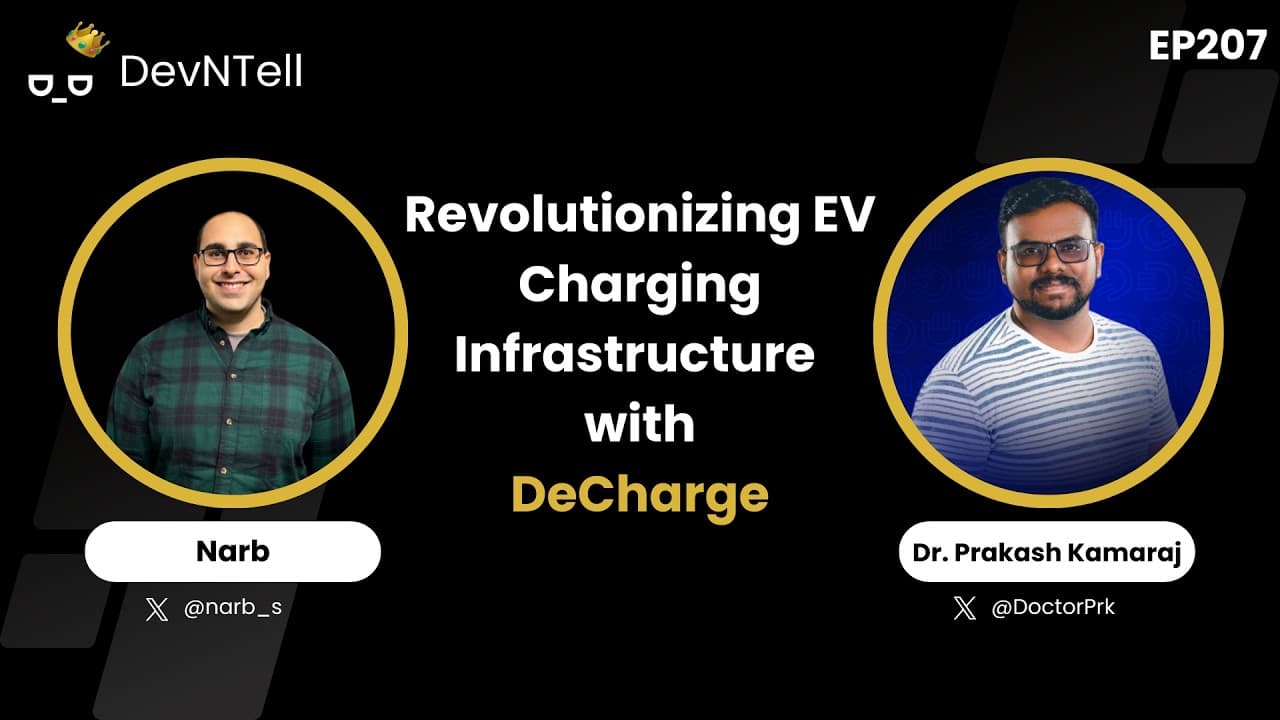
DeCharge Is Building a Community-Owned EV Charging Network on Solana
Public chargers operate at below 10% utilization. That number, cited by Dr. Prakash Kamaraj in a recent conversation about DeCharge, sits alongside another striking figure: there is currently only one public charging station for every 40 electric vehicles on the road globally. EV demand is growing at roughly 30% per year, yet the infrastructure meant to support that growth is, in his words, a "coordination nightmare."
Listen on your favorite platform
View full episode detailsFrom Medical Doctor to Crypto Builder
Dr. Kamaraj's path to co-founding DeCharge is not a straight line. Twelve years ago he was practicing medicine, then shifted to MedTech engineering through a master's degree, then moved through startup work until the pandemic period changed his direction again. His entry into crypto came not from trading alone but from two books: "Mastering Bitcoin" and "Mastering Ethereum." He credits those texts with giving him a foundation he could then explain to others around him in plain terms.
From there, Chainlink and Polygon hackathons, and then the Solana community. Patrick Collins, the smart contract developer and educator, came up as a specific influence. Dr. Kamaraj recalled asking basic questions in Discord channels and receiving personal, detailed responses from Collins, even during a period when developer tooling was minimal. That kind of direct helpfulness showed him what was possible in the space just by being genuinely useful.
By late 2023, Dr. Kamaraj met his co-founder, who serves as CEO and acting CTO at DeCharge. The two wanted to build something lasting rather than something chasing a trend that would shift in three months. That search led them to electric vehicle charging infrastructure.
One Charger for Every 40 EVs
The EV charging problem, as Dr. Kamaraj describes it, is not a demand problem. It is a coordination problem. Capital gets deployed to the wrong locations. Some chargers sit empty all day while others have long queues. Some simply do not work. The result is a fragmented network where public chargers see utilization below 10% on average, even as the number of EVs on the road keeps climbing.
"We focus on just one question: how do we make charging infrastructure programmable? EVs are growing exponentially but the infra coordination can't keep up, and I think the way we are approaching is far more superior to most of the centralized way of approaching this problem statement."
DeCharge's answer is a community-owned model. Community members buy chargers, grant DeCharge permission to deploy them, and DeCharge places them at locations it has identified as profitable based on demand matching. The buyer then earns incentives tied to usage. The company does not accumulate chargers on its own balance sheet. As Dr. Kamaraj put it, the concept is "almost like Airbnb for EV charging that is meeting Stripe for energy."
The network has deployed close to 300 chargers over roughly two years, a pace of approximately two chargers per day. Dr. Kamaraj noted that contemporaries with similar capital have taken years to reach comparable numbers.
Think of It Like Helium, Hivemapper
DeCharge sits within the decentralized physical infrastructure category, and Dr. Kamaraj draws an explicit comparison to Helium, the community-deployed wireless network. The parallel is intentional. Rather than a single company constrained by geography and capital, a distributed operator network can grow faster and with more local knowledge.
"Helium as a network still blows my mind. Because how is it even possible you have so many people deploying hotspots, whereas through an average person if you go and talk about Helium it gets them at least like a couple of weeks to figure and wrap their head around it because they don't understand how the incentives work, but it really enables the operator network in mind."
DeCharge's model adds a layer Helium does not: the company handles deployment on behalf of charger buyers, leaning on its existing business knowledge to make sure units land at profitable spots. That removes the operational burden from community members while still distributing ownership. There is also a business-to-business component. Fleet operators such as Uber India or Grab and Gojek want guaranteed charger availability because EVs carry a lower cost per mile and price sensitivity runs high in those businesses. DeCharge positions itself as a network that can meet that guaranteed utilization need without being tied to a single charge point operator.
Pokémon Go but You Don't Have to Go Around
During the conversation, Dr. Kamaraj shared a live look at DeCharge's Scout App, currently in early alpha. The app lets users scan their surroundings and aggregate information about nearby charging stations, including notes, amenities, and operator details. All of the data is user-generated. Dr. Kamaraj described building portions of it while traveling to Hong Kong and Singapore, scanning chargers along the way.
The app pulls from Google Maps, PlugShare, and the Open Charge Point Protocol (OCPP), the globally compliant standard that DeCharge built its protocol layer around. One key difference Dr. Kamaraj draws between DeCharge and a network like Tesla's is monetization: Tesla's protocol does not allow hosts to profit from their chargers, while DeCharge's model is built specifically around enabling that revenue stream for operators.
A route optimization feature was also visible in the demo, showing a simulated trip from Hong Kong to Bangkok with charging stop planning and cost optimization based on time of day. A user in Denver had already contributed scan data from the US. The Scout App is accessible at scout.decharge.io, and the team plans to run bounties for contributors. The longer-term developer angle involves opening APIs covering charger locations, real-time telemetry, and eventually energy-based triggers like optimal charging windows, once enough data is gathered across a given city or region.
Token Comes Last
When asked about advice for aspiring founders, Dr. Kamaraj was direct about where builders often go wrong. He drew a distinction between "narrative pain" and actual operational pain points, the kind that come from experiencing a problem firsthand. The story around a product matters, he said, but it has to come from somewhere real.
"Building cost of building software has come to be basically zero. So it's very important to show why your product should matter to the users and how your solution is any better. You want to resonate through your problem statement and your pain points."
On the question of tokens specifically, his view was plain: "Token comes last, that you don't even need a token to begin with. You have a very good fundamental problem, everything else follows really well around you."
DeCharge's choice of Solana was, by Dr. Kamaraj's own account, partly circumstantial. His proximity to the Solana community predated DeCharge, and the chain's low costs and maturing developer tooling made it practical. He noted fond memories of contributing to GnosisDAO and Ocean Protocol, acknowledging work happening across multiple ecosystems, but said the team found Solana's ecosystem support to be a practical fit for what they were building.
The Scout App's soft launch during this conversation marked a public step for a project that has been operating largely through community channels. Expanding into the US market is next on the agenda, where charging infrastructure costs more to deploy but where community participation, Dr. Kamaraj suggested, could help absorb that gap.