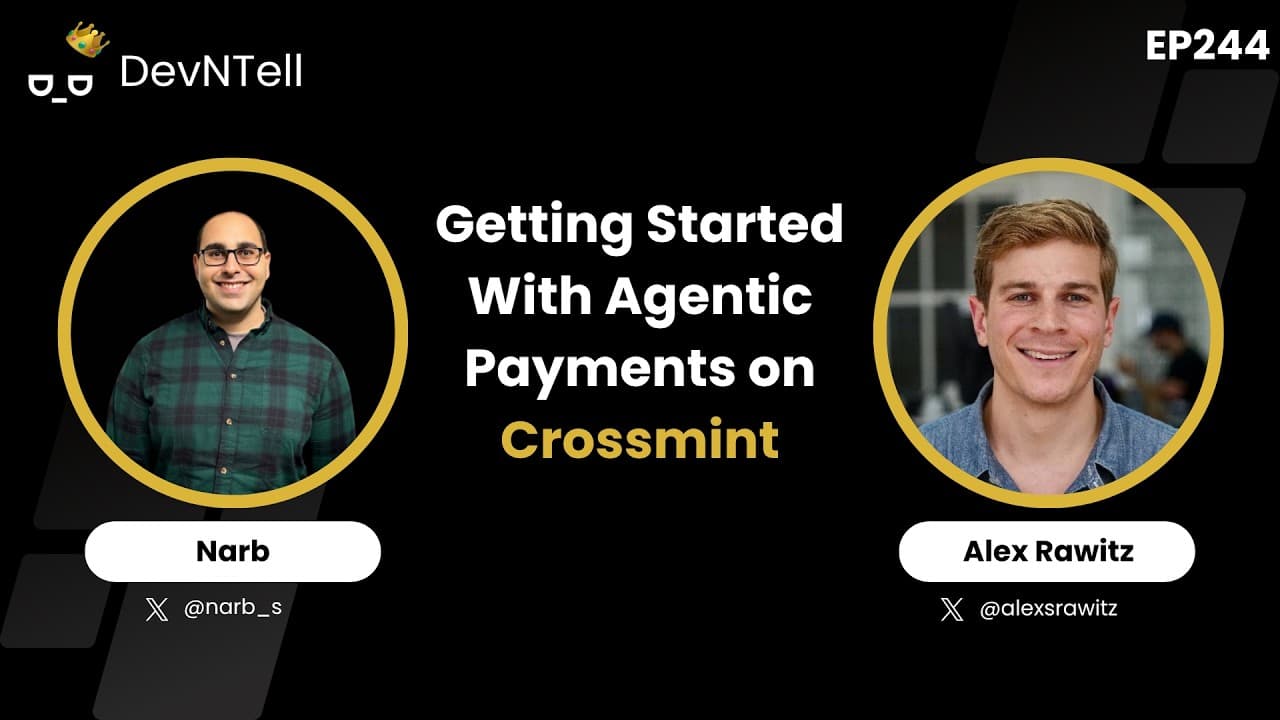
Crossmint's Alex Rawitz on Agents That Shop: Delegated Signers, Saved Cards, and a Pair of Gloves Bought Live
Alex Rawitz is Head of Agentic Payments at Crossmint, a company that provides wallets, stablecoin infrastructure, and payment tooling through APIs. The day before the recording, Crossmint announced its Agent Commerce Toolkit, and a good part of the conversation went to watching that toolkit buy something real on a live checkout page.
Listen on your favorite platform
View full episode detailsMachines Moving Money
Rawitz came to agent payments through machines rather than chatbots. He has spent almost 15 years in tech, starting at a startup accelerator and then moving to an IoT company that built hardware and software to remotely monitor telecom sites. While he was there in 2016, he read early work on how Ethereum and smart contracts could enable machine-to-machine payments. He went on to spend almost three years at Chainalysis, then founded DIMO, a protocol for putting machine identity onchain, which he built for five years before joining Crossmint.
"So it's been a journey that has taken me in and out of the Web3 world, it's taken me in and out of payments, it's taken me kind of like in and out of a few of these different areas, but somehow I always find myself intersecting with how is money getting more and more programmable and how are non-human actors going to move money."
He dates the shift from thinking about LLMs as chatbots to thinking about agents to OpenClaw, late last year. He built his own agent and started writing skills, and quickly ran into the limits of his patience: "I'm not a dev, I have no interest in DevOps!" The next turn came when Muse and Instinct shipped back to back. In its first week, Muse offered users three suggestions, one of which was to buy them something.
"It was like: oh my god, here's an inflection point. And we went from like: agents will probably buy something one day, to: oh, of course agents are going to shop for us."
That early period also produced a problem Crossmint saw in its own data. Many OpenClaw users gave their agents a credit card number and stored it somewhere they considered relatively secure. "There was quite a bit of credit card leakage in that world," Rawitz said. An individual can accept that risk, but a company offering an agent service to other people runs into the compliance rules that govern how card numbers are handled.
Rawitz also pushed back on the online debate over which category agents will buy first, whether flights or groceries. After talking with hundreds of people, he found their answers all over the place. "There's no right answer to what agents will buy first," he said.
From GOAT to Delegated Signers
By Rawitz's account, Crossmint has been around for about five years and began as a way to run NFT launches. Its early contribution was a headless checkout that let buyers pay for an NFT with a credit card or Apple Pay. As NFTs faded as a commerce category, Crossmint became a stablecoin company, providing onramps, offramps, and wallets to companies including MoneyGram and Robinhood. In September 2025, Crossmint announced that its infrastructure powered a MoneyGram cross-border product in Colombia that delivers remittances as USDC to recipients' smart wallets.
Crossmint's first agent product came almost two years ago: GOAT, an SDK for giving agents access to onchain actions. It was released under the MIT license and works with any wallet provider. Rawitz said its central question still shapes the products today: how to give an agent a wallet in a controlled, permissioned way. Crossmint builds smart contract wallets, encodes the relevant policies onchain, and separates operational signers from recovery signers.
"If you want to give your agent access to a wallet, provision a wallet to the person and give the agent a delegated signer," Rawitz said. One wallet can have several signers with different budgets and purposes, or a separate signer for each agent.
Cards came next. Crossmint supports Visa Intelligent Commerce and Mastercard Agent Pay, and in June 2026 it launched an Agentic Cards API with Visa and Basis Theory. The final piece was a checkout API, because, as Rawitz put it, "once you've given the agent access to some money, it still has trouble buying things."
The biggest change in the new toolkit is that it is self-service. Crossmint's regulated products, such as onramps and offramps, require KYB checks and long onboarding. The agent products still have risk checks, particularly around the card network programs, but developers can reach production without a sales gate. Crossmint also published three sample apps meant to be forked.
A Glimpse into Agentic Commerce
Rawitz showcased the Agent Commerce Toolkit in action with a live demo of an agent purchasing something on his behalf with a real credit card. On top of the controls the card networks are adding, developers can use Crossmint's SDK to set budgets and authorization gates. That allows a deferred instruction, such as buying an item once its price drops from $60 to $50. Rawitz estimated, calling the figure anecdotal, that about 95% of agent purchases today are "buy it now" requests, though price-watching requests are growing.
"The way things work today is that 99.99% of the web is inaccessible via API," he said. Crossmint's tooling first checks whether the merchant supports an agent protocol such as UCP or ACP. The merchant in the demo did not, so the order fell back to browser automation, which Crossmint built in-house on top of browsers from Kernel. Persistent sessions mean a user who logs in once can check out faster the next time. The agent filled in the form, stopped once to ask Rawitz a question, and finished in about a minute, close to the 60-second average he cited. The order confirmation landed in his inbox shortly after.
Waiting on the Merchants
Rawitz expects merchants to eventually require Know Your Agent (KYA) identification and anti-fraud checks. An agent will arrive and announce, in his words, "hey, I'm Alex's agent, here's why you can trust me, and here's my W3C credential." Crossmint plans to build that into its checkout API, so that over time the API works directly with merchant protocol endpoints instead of automating browsers.
When Narb asked what is holding merchants back, Rawitz said he did not think the cause was technical gaps in the protocols. "I think it's purely behavioral," he said. Large merchants can afford to wait, and he cited a figure that only about 2.5% of US households pay for an agent or LLM subscription.