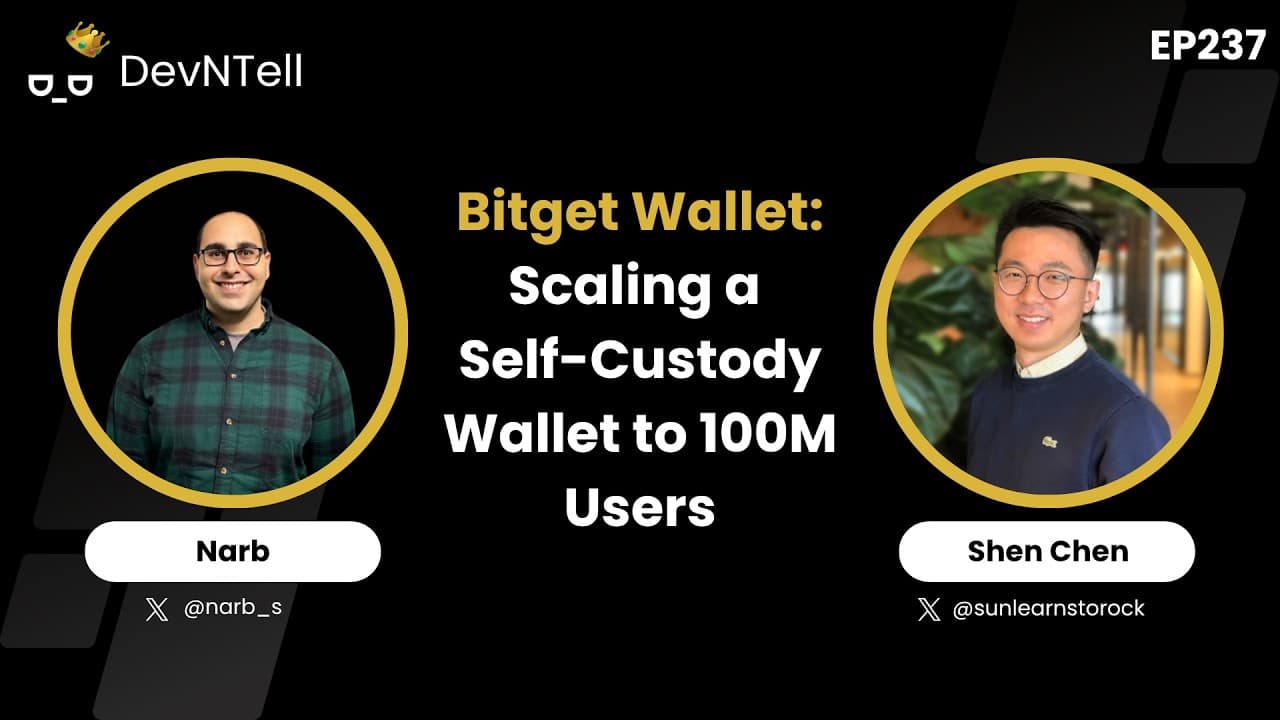
Building Infrastructure for One Hundred Million Self-Custody Users
Shen Chen spent twelve years at Honeywell before he had heard much about crypto. It was his first job out of college, and he assumed he would retire there. "At Honeywell, like you said, I thought I was going to retire at Honeywell," he told Narb on DevNTell. What pulled him out was a single localization project that started in China, where he became the product manager and marketing leader and then carried the product from China to a global market. That work eventually brought him to the United States. By his own account it took him ten years to grow that business from nothing to more than $100 million, a pace he now considers slow. "It took me 10 years to go from zero to actually over $100 million," he said. "But compared to crypto, I think that's probably too long."
Listen on your favorite platform
View full episode detailsTwelve Years at Honeywell
The move into crypto came in 2018, after a friend joined a startup called BloxRoute and spent six months lobbying him to come along. Shen knew nothing about the space and expected his old skills to be useless. He found that the habits of verifying market opportunities, digging into user needs, and adjusting a pitch for traders, builders, or institutions carried over. From BloxRoute, which introduced commercial private transaction services before Flashbots, he went to Blocknative and then to OKX, where he led the developer platform and later X Layer partnerships, landing deals with Aave, Uniswap, and the stablecoin issuers behind USDG and USDT0. Both BloxRoute (acquired by FalconX) and Blocknative (acquired by Deloitte) changed hands within about sixty days of his arrival at Bitget Wallet.
His experience at BloxRoute exposed him to trading infrastructure and maximal extractable value, or MEV. Shen noted that the company was a pioneer in introducing private transaction services to protect users from front-running, a concept that was two years ahead of the market at the time. Today, MEV protection and private transactions have become standard features for modern wallets and provide a new source of revenue. At Blocknative, Shen focused on mempool exploration and gas estimation tools, building the partnership team that took the business from its initial product phase to broader adoption among application builders.
From BitKeep to Bitget Wallet
Bitget Wallet started in Singapore in 2018 under the name BitKeep. In 2023, Bitget Group became a major shareholder, and the wallet was renamed. Shen is quick to correct a common assumption that the product is simply an exchange extension. "Today, a lot of people think that we are an exchange wallet, but in fact we are not," he said, noting that the two even use different logos and only share a name. Being part of the Bitget ecosystem still helped the wallet grow its user base tenfold within a couple of years. The company now reports serving over 100 million users.
Building a successful wallet business is notoriously difficult due to low entry barriers, high operational costs, and historically unclear business models. Shen said the success of the platform stems from its expansion into a one-stop trading hub. This includes an in-house DEX aggregator that routes liquidity across more than 130 blockchains, an Earn platform, and prediction markets that ranked number one by user count during the World Cup. The wallet also integrated support for Bitcoin, Solana, TON, and Aptos, while adding contract-risk detection to protect users from malicious scripts. A major milestone was the launch of an RWA portal, where the wallet was an early volume contributor for Ondo and now offers access to Reality, a tokenization platform recently launched by the group.
The Plumbing of Global Payments
Trading has been the dominant use case for crypto, but Shen argued that it has a natural ceiling. Payments address a more universal need, particularly in emerging markets where unbanked populations face high local inflation and strict foreign exchange controls; however, Shen was blunt about the gap between regulatory progress and actual infrastructure readiness around crypto payments. While the industry cheers for new legislation and stablecoin growth, the operational work of connecting blockchains to card networks and merchants remains a bottleneck.
People think, "Oh, now we have the Genius Act, we have all the regulation, we have stablecoins, now crypto payment is going to take off." No, you don't have the infrastructure!
To bridge this gap, Bitget Wallet developed what it calls the Onchain Payments Matrix. This infrastructure coordinates settlement across stablecoins, banks, and local payment systems. The company reports having processed 155 million stablecoin transactions worth more than $177 billion. Shen said that payments growth has already surpassed trading growth in terms of user acquisition, reflecting a shift toward crypto as a tool for everyday finance rather than just speculation.
Outside of the Crypto Bubble
Despite the enthusiasm for AI and autonomous agents, Shen maintained a cautious outlook on immediate mass adoption. He pointed out that the crypto community often operates in an echo chamber, assuming that internal trends will immediately translate to the wider world. During his time at OKX, his team explored partnerships with AI builder communities and found that core AI developers are not necessarily crypto-savvy, and payments sit low on their priority lists. Large corporate environments present a second hurdle, as businesses like Honeywell and IBM depend on legacy ERP systems built on technology from decades ago. Overhauling those foundations to be AI-compatible is slow and complex work.
His test for real adoption is based on current user behavior. "How many people are actually able to install and run an agent by themselves? A very tiny percentage of people," he said. He compared the current AI hype to earlier trends like DePIN, which solve real problems but often get ahead of actual demand. Bitget Wallet is incorporating AI into price notifications, market signals, and internal workflow efficiency rather than attaching the label to every feature. Shen suggested that builders should focus on whether their products are usable by people outside the technical bubble which has been a long standing issue in crypto industry.